Author Archives: Him

Assembly Required

Making a pot roast is easy, really, especially for two–one to chop the vegetables, one to brown the beef and vegetables and add the flavorful liquid. The sous chef’s duties may also include removing the smoke alarm from the kitchen, but that isn’t the case in every household.

Building furniture is more challenging. Heck, finding the right furniture is more challenging.

Now that the floors and walls in our Writers’ Room are finished and quite lovely, we decided that I should have a proper desk rather than balancing a musical keyboard on two plastic file bins with a jerry-rigged typing keyboard tray beneath it and a metal cart to hold a computer monitor behind.

I found a desk online that seemed perfect in every way except cost–after paying for the floors and walls, a thirteen-hundred-dollar piece of recording furniture that I’d never even touched was risky and extravagant.  She ventured to Ikea in hope of finding something we could customize to my needs, and returned with a carful of boxes containing an assortment of possibilities. She also brought a new desk for herself. (She hasn’t felt like her laptop has a real home–that is, when it isn’t on her lap.)

While the pot roast braised, we opened boxes, sorted parts, deciphered pictographic instructions, fitted Tab A into Slot B, and tried to remain patient with ourselves and each other. The challenge was increased by the latening hour, the knowledge that the laundry wasn’t finished, and that a long week stretched ahead of us. It seemed possible that we were about to disprove our belief that only one of us melts down at a time.

When a timer beeped to let us know dinner was ready, a break was declared. The pot roast was hearty and moist, the vegetables tender and sweet. Served with a little cranberry juice and ginger ale, we were fortified.  We set another timer as we resumed our work: we were going to finish the project in 30 minutes or leave it for another day.

27 minutes later, not a spare dowel or screw was left over. Her desk was beautiful, functional, and sturdy. The table portion of mine was assembled; the gathering and placing of electronic equipment was Monday’s project, and the return of unused components would happen later in the week. I’m not sure if I’m more impressed that we completed the tasks without undue fussing or that she actually knew the proper name of ubiquitous metal Ikea-furniture-connectors: camlock.)

Ikea once made a video pitting a couple of long-standing and a pair who’d only been dating a short while in a race to see who could assemble a piece of their furniture more quickly and successfully. One of the participants said, at the finish, “IKEA is like love. The instructions aren’t always clear. Sometimes you think you are doing it wrong but at the end of the day, you’ve built a desk together.” We’ve known each other a very long time, but the our current relationship status is relatively new; I don’t know, really, which side of that relationship test we belong on.

We built a desk. (Two of them, in fact.)

Her desk is ready for a laptop and a pad, with a cozy rocking chair for reading, or waiting patiently while a collaborator finishes a new scene or song.

Her desk is ready for a laptop and a pad, with a cozy rocking chair for reading, or waiting patiently while a collaborator finishes a new scene or song.

His desk is still a work in progress, but everything fits. Let the composing begin!
His desk is still a work in progress, but everything fits. Let the composing begin!
The Best Sauce

It has been one of those weeks.

For a project with “dinner” in the title, there has been a whole lot of no-dinner-cooking at the Country House.

I missed a train on Monday–by moments!–and so had to drive into New York in order to get to a meeting.  She met me after, and we drove home together, but by the time we arrived, nobody much wanted dinner. (It could have gone entirely the other way; we might have wanted all the food there was, and then some.)

We both worked late on Tuesday, and had had late lunches; again, no dinner-making.

Wednesday was a theatre night; last weekend, I realized that she’d never seen a long-running musical written by two friends of mine, so we went to see it; we met for a bite on the way. I took a photo of our dinner, but the meal hardly seemed like writing about. The food was fine; the show was delightful.

She worked really late on Thursday in order to take a train that arrived just in time for me to meet her after choir rehearsal. I made us a snack to eat while watching a little TV before bedtime, but it wasn’t a real meal.

On the way to a slightly-later-than-usual train this morning–which she’d decided to take after working late four days in a row–we decided that we were going to stay in this evening.  No theatre, no movies, no trips to furniture stores, no visiting friends; a night at home. She asked for “something light.” I’m glad I asked her to be more specific; given that direction, I might have made a big green salad. She had in mind some white fish; perhaps some rice; and maybe green beans or asparagus. It sounded like a plan to me, so I stopped at the market on the way to meet her evening train.

The menu was her idea, so she started cooking.  (Also, I couldn’t do much in the way of meal prep, since she had me sticking my head under a towel with a bowl of steaming water and herbs to clear a stuffy nose. I was, however, able to look up fish-baking time on my iPhone.)

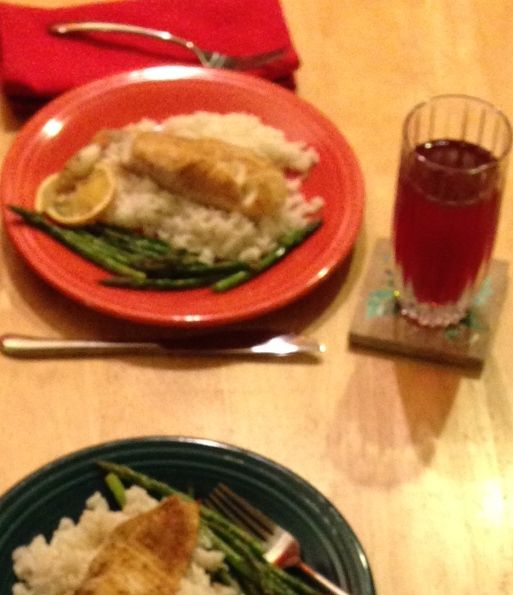
30 minutes at 375ºF later, there were two perfectly-baked tilapia filets, each topped with a sprinkling of Old Bay seasoning and a lemon slice.  There was a pot of nutty rice, fragrant with thyme. There was a hot skillet, into which barely-steamed asparagus had been tossed with a little olive oil, garlic, salt, pepper, and a squeeze of lemon.  Fancier than a peanut butter sandwich or a bowl of ramen noodles, but it seemed not at all elaborate. It was just right.

Or maybe we were just hungry.

It’s said that hunger is the best sauce, but that doesn’t necessarily mean a physical need for food; the best sauce might be the desire to have a quiet dinner at home, at a decent hour, with some pleasant music playing, and the best possible company.

We cleaned our plates.

Tilapia, rice, asparagus. A glass of juice. Nothing more is required.

Tilapia, rice, asparagus. A glass of juice. Nothing more is required.

Babycakes

On a Friday night not long ago, we’d been looking forward to watching the PBS broadcast of a theatre production that featured some people we know. Unfortunately, she fell asleep on the couch before the show started.  I puttered around on the internet for a while, surprised at how many programs PBS made available as streaming video.  A series of short cooking videos called Kitchen Vignettes caught my attention. Beautifully shot and set to lovely music, they were educational, though there was no voice explaining the recipes being demonstrated.

I was especially intrigued by one called “Groaning Cake.” I wasn’t sure what sort of cake might groan, but the soundtrack–a recording by the folk singer Heather Kelday–held me. I learned from the text displayed in the video, that Groaning Cake is a traditional postpartum food.  It’s a very rich, calorie-dense spice cake made with whole wheat flour, carrots, zucchini, and apples.  It might even be considered healthy, save for the great deal of butter, the many eggs, and the gobs of honey and molasses.

In the video, a woman is shown baking the cake. She’s very pregnant, a fact which the filmmaker apparently wants us not to forget for a second.  Every shot that isn’t a closeup of ingredients going into a bowl is of her swollen belly or breasts. In the last moments of the video, we see the beautiful child, and a fellow who is likely the father; then the new mother feeds her partner the first slice of cake.

That’s where they lost me.

The idea seems to be that a new mother will have neither the time nor energy to cook after giving birth, so this cake would keep her fed while she regains her strength. If I followed the timeline, the woman baked the cake, gave birth, and then fed the cake to the guy. Was he not capable of turning on the oven, grating some zucchini, and measuring the cinnamon and cloves? Was he, at the very least, not up to the task of cutting a slice of cake for the mother of his child?

Maybe it’s all the breakfasts I’ve made and lunches I’ve packed, but it just seems fair that she would get the first bite. Of course, what do I know? I’m not a father. Maybe standing around while someone else does all the really hard work is harder than it seems. A guy can probably burn a lot of calories by pacing.

Friends of ours recently had a baby–a beautiful son. Of course we had a bear to give to the new baby; every child should have a good, sturdy bear to keep him company. But we thought we should do something more.

We baked them a Groaning Cake.

The cake takes its name from a woman’s cries during labor–which, some say, is induced by the preparation of the cake.  Somewhere around the third stick of butter (or maybe the fourth egg, or the half-a-jar of honey) I began to think the name had another meaning: when I felt how heavy the pan of batter was, I may have let out an involuntary grunt. At least I didn’t spill it on the way to the oven.

On Sunday afternoon, we wrapped up the cake and went to visit the proud parents and meet the baby. It tasted as swooningly good as it had smelled while baking (a fact I learned after the new mama got the first bite). It was also, it turned out, slightly underdone. It wasn’t hazardously soggy, but it is likely that I added too much of the apple-carrot-zucchini trifecta, and the batter was simply too moist to ever fully set.

The new mom and dad were too sleep-deprived to notice any baking issues. The baby was happy, calm, and snuggly–and he wasn’t going to get any cake, anyway. At least not today.

There aren’t any babies at the Country House.  It would be a nice place to raise a child, but it’s too far away from her office, and from where much of my theatrical work is, to be practical. We’d spend all of our time commuting and either never see the little one, or never see each other. That might change one day, but for now, we try to be good and loving examples to the children in our friends’ lives.

And if it does change, you can bet that she won’t have to bake her own cake.

The Second- or Third-Best-Laid Plans

Our plans began, as is so often the case, with an iMessage.

I know what to make for dinner! Mulligatawny Soup.  It’s usually served over rice, but crumbled cornbread will also do.

I was driving when the message came in, so I didn’t respond right away. I like her Mulligatawny Soup, rich with chicken, peppers, and spices, and thick with rice. I started trying to remember how many of the ingredients we had on hand.  When I arrived at the station to meet her train, our conversation didn’t go straight to food, though if it had, I might have said, “Mulligatawny is a good idea, but I could really go for a pile of vegetables, a little protein, and maybe a dinner roll.”

We headed off to the very large home improvement store to purchase electrical supplies. Her parents were arriving the next morning for a visit; her dad, a skilled electrician, was going to teach us how to install new electrical outlets. By the time we’d found everything on our shopping list, neither of us was in the mood for going to the market, much less cooking afterward.

“Let’s go out,” she said. “But to a place where it’s okay to be dressed like I am.” I was in dark jeans, a sweater, and a tweed jacket. She had worn jeans and a blouse to the office, and looked good enough to get into any restaurant I’d want to go to.

At a traffic light, the plans amended again. “We could just get take-out…”

We cruised slowly down Route 1, neither of us quite sure what would be on the menu. A favorite casual Italian place presented itself, and we stopped. And the plan amended again. “While we’re waiting for our entrees, let’s have a drink and an appetizer.”

“You’re going to laugh at me,” she said, looking up from the menu. (Plans were apparently changing again.) “Instead of a full meal, why don’t we share some appetizers and a salad?” I would never laugh at a girl who doesn’t particularly like vegetables ordering a salad. We considered the merits of the salad she had in mind, and settled instead on a sampler of appetizers–a few meatballs, a few chicken wings, and some breaded mozzarella–and a platter of roasted vegetables. We placed our order, and, as we sipped our drinks and toasted the good fortune of friends who’d just had a child, the waiter appeared with a bread basket.

It was my turn to smile. We had started by thinking about mulligatawny soup and ended up with a pile of vegetables, a little protein, and maybe a dinner roll. And we were both delighted with the evening.

Yes, And

“Are you making beef with broccoli?” she asked, sounding equal parts amazed and teasing.

I like vegetables.  Broccoli probably comes in third in my list of favorites, behind brussels sprouts, which are coming into season and filling me with delight and anticipation, and green beans, for which I think the USDA’s recommended serving size ought to be, “Well, how many have you got?”

The thing is, I wasn’t making beef with broccoli. I wasn’t sure what I was making, though.

We’d both worked late, and she was feeling in the mood for something bland, so she was heating a bowl of mashed potatoes to have with butter, salt, and pepper. I was foraging. I’d found a little piece of rare beef and some rice; the latter, topped with a damp paper towel, would go into the microwave when her potatoes were done.  The rice wouldn’t be as good as it had been when freshly cooked, but far from terrible. I figured I’d thinly slice the steak and sauté it quickly in a little olive oil, slice a few grape tomatoes and toss those into the pan, too, and then pour it all over the reheated rice.  Maybe add a little salsa.  Maybe grate some cheese over the top.  It could be vaguely Tex-Mex. It was sort of a plan, but not quite.

There wasn’t anything green, though, and I think dinner should almost always include something green.  But I didn’t feel like assembling a salad. There were some broccoli florets, though. They got a quick steaming along with the rice, then went into the hot pan to brown on their tips, along with a generous splash of teriyaki sauce and a dab of minced garlic. Everything topped the rice, and the lot was garnished with a sprinkle of sesame seeds.

Meanwhile, she discovered to her horror that we were out of butter. “You can check in the freezer,” I said, “but I’m afraid there’s none there.” She opened the door and proved me right. But there was a little bag in the top compartment of the door containing small blocks of frozen cream. (She’d needed a very small amount for a recipe last winter. Not wanting to waste, we froze the rest in an ice cube tray and have been using it, a little at a time, ever since.) “Defrost one of these,” I suggested; “It’ll add some creaminess.” Instead, she pulled an empty pint-sized jar from the cupboard. “No!” she said.  “I’ll make butter!”

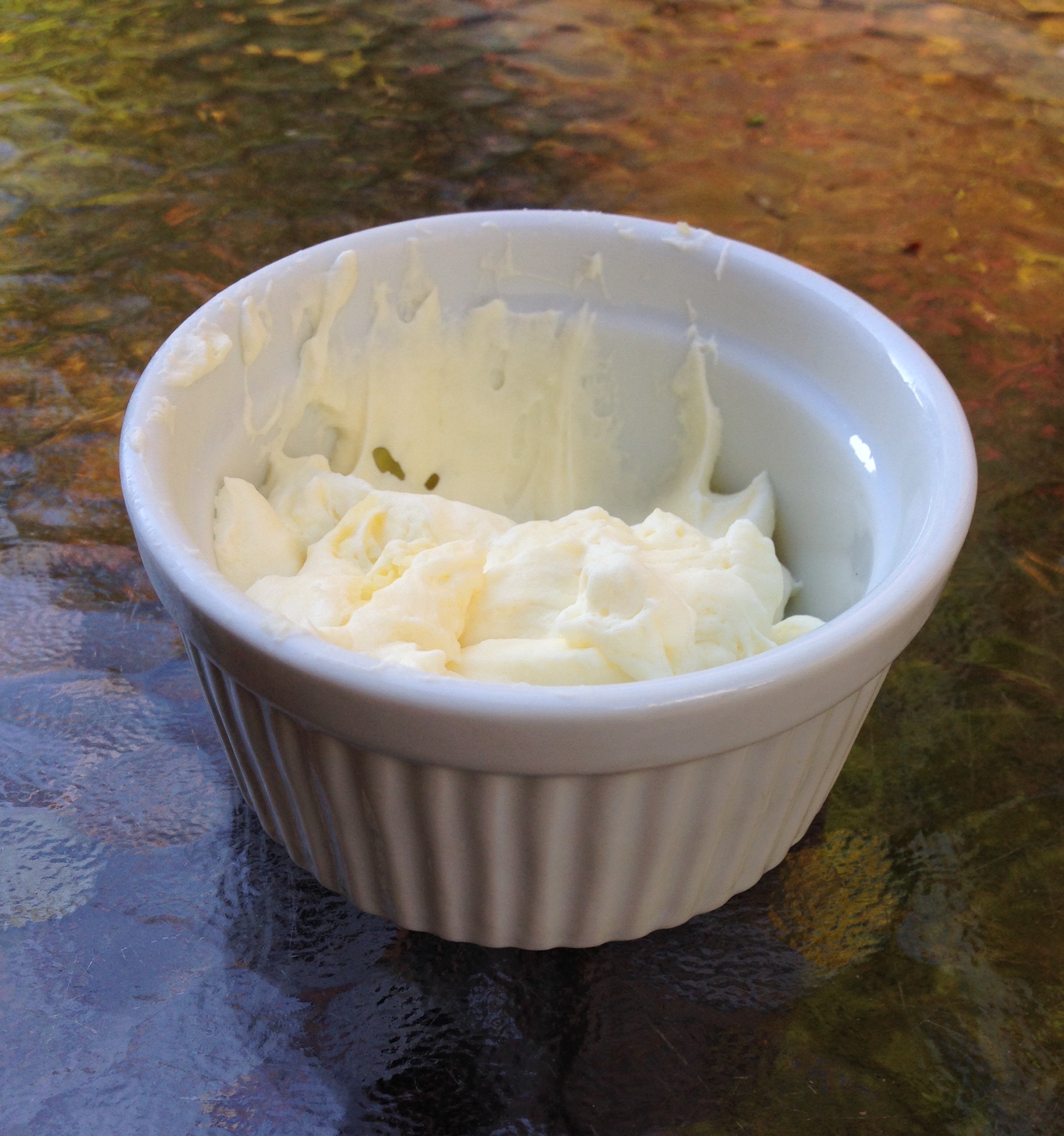
She thawed the cream and put it in the tightly-lidded jar, then danced about the kitchen, singing and shaking her jar of cream like a maraca. After a couple of minutes, she stopped, disappointed that her jar wasn’t really well-suited for churning butter or adding percussion to a vocal arrangement.  She poured the only-barely-clotted milk into the bowl of her Kitchen Aid mixer, and sent it to whisk. 8 minutes or so later, she had a ramekin of soft, lovely butter. I don’t think we’ll give up buying it in sticks from the grocery, but it’s nice to know that it’s an option.

The first rule of improvisational theatre is “Never say no.” If you’re playing a doctor in a scene and another character enters saying her car won’t start, you can’t object that you’re not a mechanic. You accept the given information and go forward.  “Yes, and I’ll bring my stethoscope to listen to its carburetor,” you might say. If you’re “enjoying” the sunshine and your scene partner says it’s raining, it’s not “No,” it’s “Yes, and now I get to use my new umbrella.” If you’re rocking your “new baby” and a new character compliments your rhinoceros, “Yes, and she has her mother’s horn.”

Yes, and…

“Are you making beef with broccoli?”

Yes, and would you pass me the soy sauce?

“Oh, no, we’re out of butter!”

Yes, and we have cream and a powerful mixer, and we can give ourselves a science lesson.

“We have to clear the guest room for the painter, and there’s nowhere to put the extra bed!”

Yes, and we can stack one mattress on top of another, and put a pea under the bottom one to see if we can feel it!

You can call it improvisation, and the result is sometimes funny, but really, it’s just two people being as creative and generous and kind as they know how. And a little bit more.

I’m going to be a contestant on a game show tonight–a live theatre presentation, not the TV kind.  The object for me and my partner–my partner whom I’ve never met, of course–will be to write a song on a randomly assigned topic, in a randomly selected musical style. For a musical. In twenty minutes.

You might think, “Well, they did that in real time on TV,” but the music on Whose Line is it Anyway? was pre-determined. Also, those comedians weren’t writing for musical theatre characters, or being judged by writers and directors. I’m a little nervous about this event–about not finishing on time, or that the style won’t be one I’m comfortable with, or that our song won’t be as funny as the other team’s. (Though “funny” isn’t one of the prerequisites, it’s probably better in a game like this to be funny than heartfelt). I don’t mind losing, but I want to do well.

Fortunately, I have lots of improvisational experience on which to draw. And, win or lose, she’ll be in the audience, and we’ll have dinner after the show, and then go home to a very tall bed. Victory could not not be sweeter than knowing that.

Or home-churned butter.

Butter

Precisely My Cup of Tea (and Her Cup of Coffee)

Serious coffee drinkers say that adding milk or sugar (or, worse, both) destroys their carefully brewed beverage.  I am not a serious coffee drinker.  I’m sure I can’t tell the difference between one single-source, estate-grown bean and another.  I have no argument with those who can; I just don’t care quite that much. (Also, I like milk and sugarAnd, on occasion, a little chocolate.)

I admit that my proportion of coffee to condiment has risen over the years, and I have developed a preference for dark roasts over lighter ones.  I appreciate the benefits of freshness, so I buy whole-bean coffee and grind it at home.

She drinks tea, and she’s pretty serious about it.  There are teas that take milk and teas that take lemon; the ones that take milk do not take cream, and so on. I haven’t had a complete education on the subject, since most of the time she prefers it one way.  So I learned to make tea for her. (Plunking a bag of Lipton’s in a mug of water that you microwave for two minutes is, it turns out, not the best way to do it.)

Most days, one of us stumbles to the kitchen to prepare our Elixirs of Wakefulness. I take the weekday shift; usually on weekends, she does the stumbling. She makes excellent coffee, a skill she acquired while working at a dairy store during college. Along the way, she didn’t acquire a taste for the stuff herself.

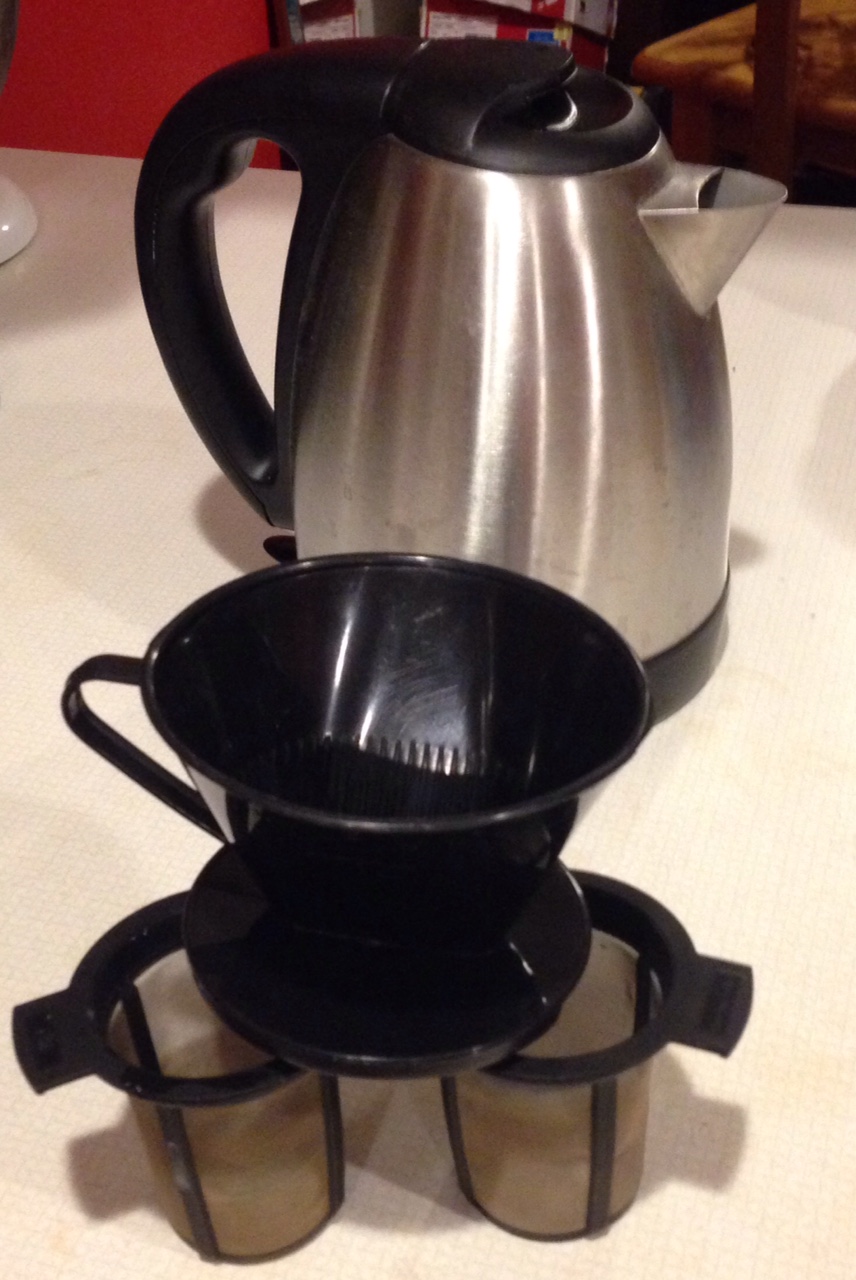
Her tea strainers are cup-shaped frames with sides of fine mesh. They allow better water circulation than ball-shaped infusers. Each holds enough leaves for a single mugful; I use two, so she can have a bonus cup before leaving for work.  For coffee, I use unbleached paper filters in a 2-cup sized cone-shaped cup-top holder. Both brews require very hot water, which comes from a trusty electric kettle that I have wanted since I first saw one in London. It’s fast, doesn’t take up a burner on the stove, and shuts itself off when the water boils rather than shrieking for attention. Also, in a pinch, you can hard-boil eggs in it. We each have a favorite mug for home, and travel mugs for carrying a cup to work. The mugs are never interchanged. There are other ways of making coffee and tea, but these tools are the ones we use most often; they give us the best results with minimal effort. We own a 12-cup Mr. Coffee and a nice teapot, but neither is used except when company comes calling.

She drinks coffee only under duress.  I drink tea when I’m recovering from a cold.  How much tea, how much coffee; how much milk, how much sugar: by now, we know each other’s cup. Are we picky about our beverages?  Maybe a little. Mostly, we know what we like, and we have sorted out how to do it. We learn how to do things, and we teach each other. We go through our days, one sip at a time.

Electric kettle, cone-shaped coffee brewer, tea strainers: aside from cat food, almost everything we need to start the day.

Electric kettle, cone-shaped coffee brewer, tea strainers: aside from cat food, almost everything we need to start the day.

Clearing the Air

Having merged two households, we have a well-appointed home. This is neither brag nor complaint, though if you need a lamp, a bookcase, some coffee mugs, or a digital piano, please visit before you go shopping.

That said, there are a few items that might make life a little more pleasant. We can purée soup or mix milkshakes using a food processor, but a blender would be less messy. We can, if we keep careful watch on the thermometer, use a Dutch oven for deep frying, but there are devices that maintain more precise thermal control. (They might not keep my crab fritters from exploding, as they did when she came to dinner once, but that was the fryer’s fault, not the Fryolator’s.) Using a stockpot, we can, well, can pickles and applesauce and salsa–well, she can can. I’d read the directions a dozen times and still fear we’d end up with botulism nachos. A pressure canner would offer a greater range of preservable recipes, with the side benefit of making pot roast a weeknight dinner possibility, but that hardly makes it a necessity.

What we do need, though, is an industrial strength exhaust fan. The one that’s built into the over-the-range microwave just isn’t doing a good job. I have yet to put a decent sear on a steak without fogging up the kitchen. She came downstairs just as the smoke alarm started to blare its alert. She pressed the reset button, but the alarm kept wailing. “Just take it outside,” I said, thankful it wasn’t hard-wired into the ceiling. As she did, she probably didn’t say, “There, there, it’s all right, he isn’t burning down the house,” but perhaps I didn’t hear her over the ineffective roar of the incumbent fan.

The steak, seared for 30 seconds a side in a very hot skillet, then finished with a brief stay in a blazing oven, was said to be “perfection.” I was glad to get it right–and glad to remember to bring the now-quiet detector back inside after the air cleared, where it stood silent sentry while we slept.

I’m Going to Go Back There Someday

I’ve never been to her favorite restaurant. We’ve talked about it many times, but we haven’t gone there for a meal yet.  It’s a very nice place, she tells me. It’s a place where a meal has a real sense of occasion.

And it’s a place where she went for memorable meals with a person she was once engaged to.

That’s not the biggest reason we haven’t gone to her favorite place. Mostly, it’s because we don’t go out to eat. We visit a restaurant before or after we’ve done something else that we’ve gone out for: to see a show, for instance. Her place isn’t somewhere you go to grab a bite before the show. When we do go there, it will an occasion, not a meal to rush through.  We’ll go there, in part, to create new memories–to reclaim that restaurant for herself, and for us.

We met a friend for dinner last week before a rehearsal. He chose a Japanese restaurant we knew he liked. We liked it, too, and not simply because it was conveniently down the block from the rehearsal space.  We’d gone there after a performance once–with him, and with the woman he was then dating. Subsequently they became engaged, but that relationship recently, suddenly, and very painfully ended.  This was the first time we were seeing him since the breakup.

Dinner was excellent, maybe the best sushi I’ve ever had. The fish was meltingly tender, incredibly fresh, and  perfectly seasoned by the sushi chef.  The addition of extra soy sauce or wasabi was thoroughly unnecessary. I’m glad the food was so good, but I wouldn’t have cared if I’d been served a bowl of Cheerios that had been left out in the rain.

He may chosen the place because of its location, or because he especially likes the food there, but we hope it was because he wanted to reclaim the restaurant as his, rather than theirs. Although the memory of having dinner with a hurting friend isn’t exactly a joyous one, it’s one that we will cherish. We may not always think of this restaurant as the place where he told us what happened, but at least it won’t any longer be the place we went with them.

Breakfast Bolognese

“Could I have a donut and a hard-boiled egg for breakfast?” she asked.

The CSA share included a dozen eggs every week, and with only two of us in the house, we always had eggs around; we kept a half-dozen hard boiled for easy breakfasts. But friends have taken over the CSA share, and our egg supply gradually diminished.  I picked up a dozen after rehearsal.

I knew I forgot to do something when I got home: there were no hard-boiled eggs. There was, however, just about enough time. I put four eggs in a pan of water along with her magical egg timer, and set it to boil.  The eggs were cooked, but, at her departure time, too hot to carry.  I offered a pig-in-a-blanket left over from race-morning brunch, some grapes, and the requested donut. From her reaction, that was an even better choice.

Having scooped out the eggs and timer, I had a pot of just-off-the-boil water. I was just about to pour it down the drain when I remembered the last of a container of bolognese sauce in the fridge.  I liked the idea of conserving resources by re-using the hot water. I put the pot back on the still-warm-but-turned-off stove, salted the water, and poured in some dry pasta. I lidded the  pot, grabbed my keys, and the took the commuter to meet her train. Upon returning from the station, I found a pot of perfectly al dente pasta.

A friend of ours posted to Facebook recently that her son was sulking because he couldn’t have macaroni and cheese for breakfast.  I presume the issue was that there was no macaroni and cheese in the house, rather than some sort of parental concern that it would be an inappropriate breakfast food. I resisted the temptation to heat the sauce and have penne bolognese for breakfast, but only because I would have felt the need to tease our friend about her son’s breakfast request.

Of course, maybe I just did.

Domestic Pas de Deux

Now and again, she gives me an impromptu dance lesson.  It happens as we’re walking along an uncrowded street. She’ll take my hand and raise hers and all of a sudden I’m in mid-spin.  The first dozen or so times this happened, I was as clumsy as could be. I’m getting a little better lately–not so much at the spinning as at recognizing the signs that it’s about to happen.  I hardly ever stumble, and I know she’d catch me were I ever to start to fall. Occasionally, the turn even approximates something dance-like. Sometimes, the lesson is more formal; usually in the kitchen where there’s plenty of floor space for a little waltzing.  We seldom do more than a few one-two-threes, but I haven’t crashed into any furniture or bruised any of her toes. Yet.

She can follow or lead. She’s apparently somewhat in demand in her folk-dancing community, where there seem to be fewer skilled leaders.  I don’t mind following, since she knows what she’s doing and I’m still learning–and I know that both partners in a dance have important roles. She’s a better teacher than I am student, but that’s because I’ve been an accompanist much more often than a dancer. I haven’t quite gotten over my shyness about dancing, but I will.

Fortunately, either of us can lead or follow in the kitchen.  I’ve done most of the leading lately, so I was happy to let her take charge as our holiday continued. She pored over a favorite cookbook and was forming a plan. The object was to make  hearty fare, especially in case we ended up with an unexpected and heartbroken houseguest.  A secondary objective was to use only ingredients that were already on hand. Thus, while happily staying in sous chef position, I suggested against recipes that called for a lamb shoulder, a whole turkey, or a big hunk of beef. Or, for that matter, more than two eggs or the cup of milk that would remain if we reserved enough for this morning’s coffee and tea.

I was a less effective kitchen aide than I could have been, owing to frequent but brief interruptions for chats with our friends in the aftermath of the weekend’s dramatic events. But nothing burned, no knuckles got scraped, and no emergency trips to the market were required. The refrigerator is organized, free of a few items that were unfortunately past their prime and well-stocked for the week. And we dined well.

The skillet rice that is one of her favorite dishes was tasted but otherwise left to cool and packaged for lunches: sausage and sautéed vegetables enveloped in sticky rice, sweet with tomatoes and warm with cumin. Southern Green Beans are nearer to a one-pot meal than a side dish, long and slow-cooked with potato and chicken stock. The recipe called for bacon; we used bacon fat and the last of a stick of pepperoni. It’s not quite the same, but no market runs! Leftover chicken subbed in for a freshly-portioned broiler-fryer; smothered in a mushroom and onion gravy, with timing adjusted to account for the chicken having been cooked already, it was ready in almost no time.  A handful of sautéed turnip greens will be fine accompaniment to a sandwich later today.  The first slices of zucchini bread that may be future breakfasts were a post-dinner treat while we strategized the evening.

Cooking All the Things

Skillet Rice, Southern Green Beans, Smothered Chicken, and Zucchini Bread. The hard part was not eating everything at once.

There was no long walk, as had been originally planned for purposes of errands and exercise.  Instead, the post-half-marathon cross-training consisted of moving furniture and packing some boxes for storage.  A very tall bed (two mattresses atop a foundation, but with no pea tucked beneath) is now in the freshly painted master bedroom, even though new flooring won’t be installed there for another couple of weeks. An improvised padded headboard protects the pretty wall behind it, and the bed’s sturdy cherry frame is dismantled and stowed. The guest room is empty and ready for painting. There’s nothing we don’t really want or need at hand, yet we haven’t put so much away that it appears we’re living in a temporary space.

Lead and follow changed place many times over the course of the day, without tension or stress, as easily as shifting weight from one foot to the other.  A choreographer might have been pleased.  By the end of the long, productive, and restorative day, we certainly were.