A Sense of Occasion

She’d worked from home on Friday while I was recording music in my basement studio.  Evening approached, and with it time to change from casual clothes into something more festive for the season-opening gala concert of a theatre company we support.

The performance was in a big cabaret space that has neither bar nor kitchen. Outside food and drink are permitted–indeed, encouraged.  I had hoped to organize some semi-elegant picnic supper for us, but getting the demo recorded took longer than I expected, and time grew short. “Can we get takeout from the Awesome Burger Place?” she asked. We could indeed.

I didn’t think about the possibility of heavy traffic most of the way to the theatre; we arrived just a few minutes before the concert began. Our fries had lost some crispness and the burgers were not as warm as they once were (and, sad to say, hers wasn’t nearly as well-cooked as she’d asked for it to be).  The store-made potato chips we’d had as a snack on the way were light, not a bit greasy, and perfectly salted.

Our picnic gear wasn’t especially classy–her wonderful picnic basket is packed deep in a closet while the painter and flooring installers work–but we looked spiffy.  The Artistic Director of the company, passing through the lobby on his way backstage, took one look at us walking in and said, “I’ll see you later, sir,” before scooping her up in a mock-lascivious embrace.

Explaining the concert’s theme, the director quoted Jonathan Larson’s Rent: “The opposite of war isn’t peace, it’s creation.” Every performance was delightful, from an Andrews Sisters tribute “Boogie Woogie Bugle Boy,” to a medley of Vietnam-era protest songs in the first act; highlights of the second act included the youngest soloist singing a very sophisticated song about parenthood with clear understanding of her text, and the 75-member cast massing their voices on Stephen Sondheim’s “Sunday” and The Lion King’s “Circle of Life.” This was our third night in the theatre in a week, and, easily, our favorite performance of the three.

At intermission, there was a silent auction with a wide array of items for bid. After the concert, we discovered that we’d won tickets to a Broadway show we want to see, a set of piano lessons for her, and a session with a running coach for me. Including dinner, concert tickets, and our winning bids, we still hadn’t spent as much as we would have for a pair of seats at the Broadway show–and we’d supported local theatre and our friends.

Usually we meet for the theatre after work. Getting dressed up for this evening and leaving the house together made it feel like a “real” date.  Although this was community theatre, there was a sense of occasion about our evening.  It reminded me of my parents going dancing at the Elks club on Saturday nights.  I don’t recall how often Mom and Dad had dinner at home before going out, but I’m pretty sure they never walked into a theatre with burgers in a paper sack.  On the other hand, maybe I’m remembering it wrong and that was exactly their idea of a good time.  It was ours, certainly.

The Best Medicine and the Bedtime Snack

It was another late evening.  She’d had an unexpected hour-long interruption in her workday, which meant rescheduling a tech-support appointment and taking a much later train.  Worse still, the support was unsupportive; and, worse than that, the lack of support came from a company known for products that don’t need support because they just work. 

She stood at the refrigerator, displaying classic signs of a terrible trifecta: tired, hungry, and indecisive.

“Eggs and grits?” I asked.

“You don’t have to make me dinner.”

No, but I could start the process, and that might help.  I took the jar of grits from its shelf; she brought the eggs from the refrigerator and took over. I looked for something that would make us both laugh. (My day hadn’t gone so badly, except for a frustrating recording session in which I proved less-than-able to sing on pitch; in any event, no day is so good that it can’t be improved by laughter.)

“Could we have more episodes of the game show?”

I had something else in mind, a segment I’d read about from a comedy news show. A segment about Ayn Rand, of all things.  She wasn’t sure it would be funny. I haven’t read Atlas Shrugged or The Fountainhead, but I know we both like this show’s smart writing and delivery.  She gave me a crash course in objectivism as we took our bowls upstairs (my eggs topped with a dab of her well-traveled salsa). One video led to another, and unhappy hours were forgotten.

Some days end with ice cream and poetry; some, with scrambled eggs and late-night TV.  Sometimes, we don’t want a snack at all. When the day’s cares are set aside, dreams are all the sweeter.

Texture, Substance, and Taste

We hadn’t gone out for sushi in quite a while, so when she suggested having dinner at East before the play we were seeing on Wednesday night, I agreed enthusiastically. We’ve been meeting there for pre-theatre dinner for years–since before she moved to New York, and long before we shared the Country House. It’s one of our favorites: comfortable and convenient, and the food is always skillfully prepared and elegantly presented.

We chose an array of items to share: a fresh, crisp green salad with a warm-and-tart ginger dressing; vegetable tempura with an incredibly light batter, which prompted a physics discussion about how the texture of carrot tempura is so interestingly different from any other method of cooking a carrot; potato wedges with an even lighter coating of the batter that had been infused with garlic and served with a roe aioli dipping sauce; and, of course, some sushi.  We both chose rolls: tuna belly and scallion; eel and avocado; and smoked salmon, cucumber, and cream cheese (or “Philadelphia” roll).

The eel was rich, well-cooked, and basted with a sweet barbecue sauce.  There’s nothing slimy or raw-fishy about it. But it’s called eel, so for many it’s off-putting. Eel needs a new marketing campaign.

Tuna belly is almost flaky, a little less sweet and not as firm as the “steak” variety but not as oily or salty as the stuff you might slather with mayonnaise and spread on white bread. The creaminess of the avocado made for a very delicate pairing.

I’m a big fan of smoked salmon and cream cheese, but I prefer them on bagels.  With cucumber, rice, and nori, it seemed an odd combination to me, but she enjoyed it a great deal.

At the theatre, we each found elements we liked and didn’t, aspects we agreed about and points of collegial dispute. As with our trip to The Country House, The Last Ship is in very early previews, so it’s hard to say how much will change before they open, and unfair to judge it too harshly.  The production was beautifully designed and skillfully presented. We enjoy sorting out what works for us and what doesn’t even if we don’t think a show is perfect.  Whether it’s a matter of texture, substance, or taste, not everyone likes the same things–sort of like dinner at a Japanese restaurant.

The Night Shift

“How do you do it?” asked her colleague, who’d arrived from Alaska that afternoon.  I asked what she meant. “How do you eat so late?”

We were seated in a Manhattan nightclub, having just ordered dinner before a cabaret performance.  It was 9 PM on a Monday. This wasn’t an early dinnertime for us, but, sad to say, it wasn’t unusually late.

It’s a combination of things. Her commute, door-to-door, is just under two hours.  I’m often working until it’s just time to meet her train. Sometimes we run errands or stop at the market on the way home. And, of course, we both prefer home cooking to takeout.

The problem isn’t a late dinnertime; lots of people eat dinner quite late.  (I’m pretty confident that the performers we saw didn’t tuck in to their dinner until after the show.) The problem is a late dinnertime that follows a long day with an early start that will have another early-starting long day after that.

She picked up dinner for herself on the way home from the train.  I’d taken some leftover chicken and dumplings to eat between office time and rehearsal.  We were covered for Tuesday.  But we could do a little planning ahead.  While she finished the last of a closet-moving project in preparation for the painter who’ll be working in the bedroom this morning, I prepared two dishes for the Night Shift.

Overnight Oatmeal

Bring 3-1/2 cups of water to a boil.

Meanwhile, in a medium sized saucepan over medium-high heat, dry-toast 1 cup of steel-cut oats, shaking the pan to toss the oats so they don’t burn.  When they’re slightly brown and beautifully nutty-smelling, turn off the heat. Add 1/2 teaspoon of salt, shake once more to distribute, carefully pour the boiling water over the oats, cover the pan, and let sit for 6-8 hours.

I used to do overnight oats in a slow cooker, but like the texture of this version much better; the oats are more toothsome than mushy. Better still, cleanup is incredibly easy. The oats simply slide out of the pan, which just needs a rinse and a wipe.

Lentil-Sausage-Kale Stew (adapted from Food52)

  • 8 oz. lentils, picked, rinsed, and drained
  • 4 links pre-cooked sausage, sliced
  • cups stock
  • 2 cups diced tomatoes
  • onion, diced
  • cloves of garlic, minced
  • 1.5 cups sliced carrots
  • teaspoon dried thyme
  • teaspoon dried sage
  • salt & pepper to taste
  • 1 bunch kale or swiss chard 

Combine all but the kale in a slow cooker, set to low; cook for 6-8 hours. Remove woody stems from the greens, chop, and add to the stew 10 minutes before serving.

Red lentils break down more than brown ones. If preparing this dish as a make-ahead, don’t add the kale until heating before serving.

At 4 AM, the aroma of the sausage-lentil stew very nearly caused me to get up for an extremely early (or extremely late) supper, but I decided to wait.

I wanted to point out to her colleague that 9 PM is really only 4 PM by her body clock, and that seems more like a late lunch than a late dinner–but she’d probably had a very early start to her day in order to fly to NYC.  And, if I have learned anything about the employee devotion of the non-profit organization for which they both work, she probably worked late yesterday, too.

Our Weekend Condition

Work had been miserable for us both on Friday; serious food was called for. I pan-grilled a steak, made a batch of macaroni and cheese, and steamed some asparagus.  She added sea salt and chopped pecans to a batch of dark chocolate caramel brownies, and tried not to be too disappointed that the peaches she was hoping to turn into jam had been waiting too long and were more mush than fruit. We sat at the table like grownups and relaxed into a weekend that would be far more full of activity than either of us expected. (She relaxed more than she planned to, falling asleep on the couch before the brownies were cool.)

Adding a little dijon mustard, paprika, and shredded muenster to boxed Mac and Cheese takes it slightly out of the realm of comfort food for some--but puts it more in the realm for others.

Adding a little dijon mustard, paprika, and shredded muenster to boxed Mac and Cheese takes it slightly out of the realm of comfort food for some–but puts it more in the realm for others.

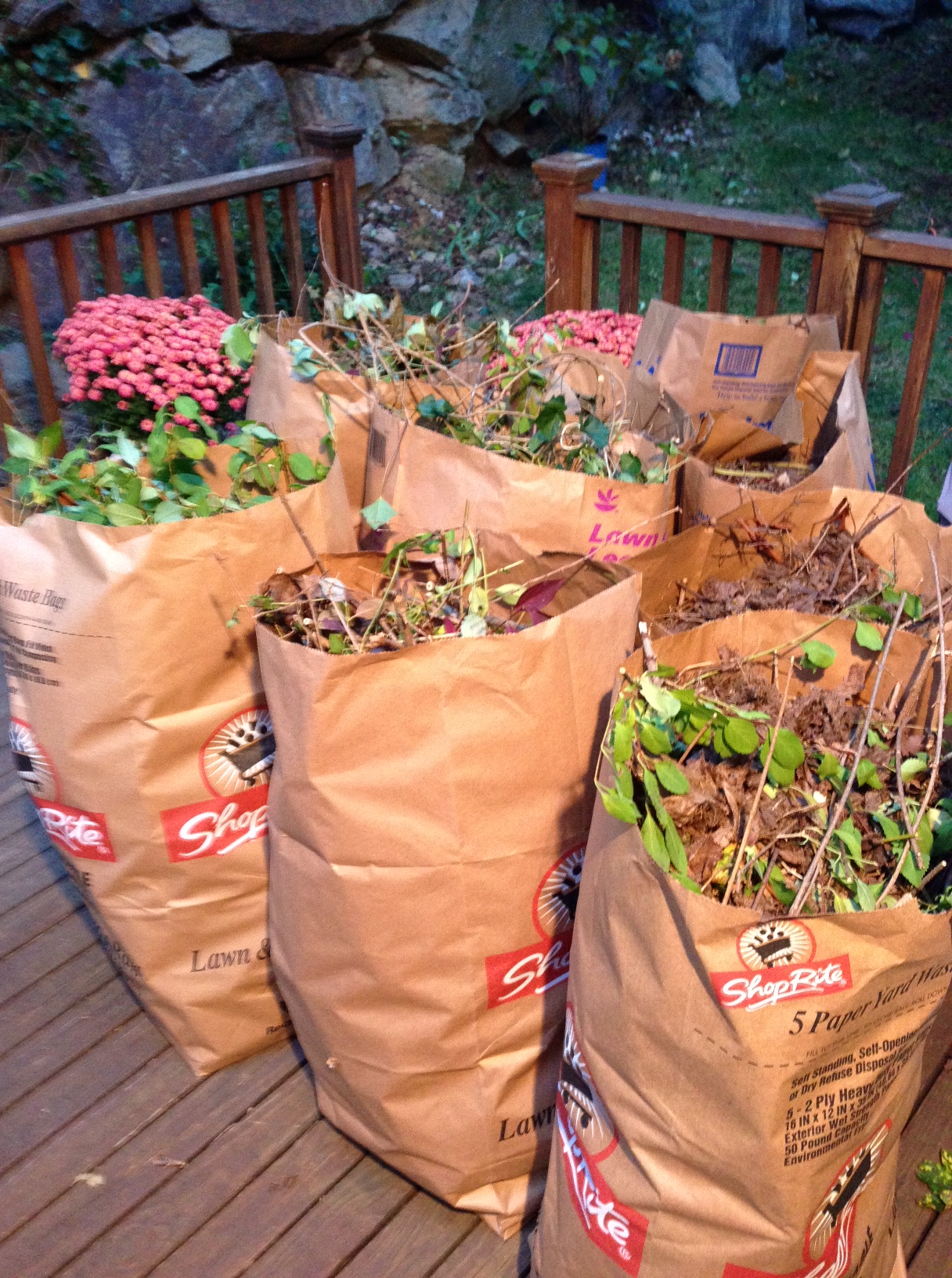
Fortified by a breakfast brownie, we started a gardening project first thing in the morning.  This was about cleaning up, not planting.  The forsythia on the hillside had overgrown, big branches of a fallen tree had become ensnarled in it, and the ivy that was supposed to be ground cover at the bottom of the hillside was tangled in everything, along with tendrils of some other weed that was the only thing really thriving.  I took breaks for two church services, but she kept at it, sending me texts periodically asking that I bring home more leaf-and-lawn bags.

Dainty food was not going to cut it. Scrambled eggs with peppers and cornbread for lunch.  Chicken and dumplings for dinner. Kahlua milkshakes for dessert, while we cheered on our friends who performed in the PBS telecast of Sweeney Todd. (Dumplings, yes; meat pies, no.)

While I started Sunday’s massathon, she climbed back onto the hillside; she was accompanied by our neighbor, and I joined the two of them between masses 4 & 5. By the end of the weekend, there was plenty of space for the ivy to do its thing, just the right amount of forsythia for the space, three Prius-loads of filled-to-the-brim leaf bags bound for the city’s lawn-waste site, and the satisfaction of a job well done and without injury.

(The first three bags were already in the car.)

(The first three bags were already in the car.)

We ordered takeout from a terrific and very authentic Mexican restaurant: soft corn tacos filled with steak and pork, pickled onion, and cilantro; chicken flautas; rice studded with bits of pea and carrot; creamy, rich refried beans. (Too much food for dinner, to be sure; we’re both having leftovers for lunch, and the guacamole and chips will be a post-theatre snack tonight.)

I preheated the oven while we ate, and with the energy conserved by ordering dinner, I gathered ingredients and she mixed a batch of cranberry-orange muffins for this week’s breakfasts. They’re not exactly the Better Homes and Gardens Cookbook recipe; it turns out she improvises, too (and then carefully notates how well things work).

Cranberry Orange Muffins

  1. Preheat the oven to 400 degrees and prep your muffin tin for 12 average-sized muffins.
  2. Zest a large orange; reserve the zest in a small bowl and then squeeze every last drop of juice into a measuring cup. Pour enough cranberry juice cocktail into the cup to bring the total volume up liquid up to 2/3 of a cup. Add 1/4 of a cup of cooking oil to that measuring cup, and stir well to combine. Set aside.
  3. In a large bowl combine 1-3/4 cups flour, a scant 1/3 cup sugar, 2 tsp baking powder, and 1/4 tsp salt. stir to combine, then make a well in the center.  Set aside.
  4. In another small bowl (or the cup used to measure the flour), beat an egg. Pour the beaten egg and combined liquid into the well of the flour, and stir to combine. Continue stirring, scraping the bowl as necessary, until all of the dry ingredients are incorporated and the batter is smooth. Fold in one cup of whole frozen cranberries (or thoroughly chilled fresh ones) and a sprinkling of slivered almonds.
  5. Scoop the batter into the muffin tins. Remember the reserved zest and sprinkle a few pieces on the tops of each muffin, giving a quick stir with a small spoon to cover them with batter.
  6. Bake until the tops are golden and the tiniest bit of brown starts to show at the edges, approximately 22 minutes. Remove the pan from the oven and set it on a wire rack to cool for twenty minutes, then remove the muffins from the cups and allow them to cool completely. Enjoy with butter or clotted cream.
As with brownies, waiting for muffins to cool is very much the hardest part.

As with brownies, waiting for muffins to cool is very much the hardest part.

We finished Sunday evening with a mini-marathon of 1950s TV game shows, confident that we would be well fed and cooking-panic-free all week, and recognition that–although there is always more to do–we’d accomplished quite a bit. Like untangling weeds from ivy, making a home takes time.

Attention Must Be Paid

She’d asked for a bagel with cream cheese to take for breakfast.  Nothing fancy. Her go-to breakfast. “With a slice of tomato, if we have any?” she asked hopefully. I knew we had tomato.

A cheddar bagel looked interesting. I sliced and toasted it, smeared on some cream cheese, added the requested tomato, sprinkled on a little salt and pepper, and crumbled on a slice of bacon. Because when there’s bacon in the fridge, why not? I wrapped the sandwich in a cloth napkin to absorb condensation and secured it in a Ziploc to keep from making a mess, tucked it into her bag and sent her off to work.

This text message came when she got to her office and opened the package:

How could you have possibly known exactly what I needed to feel human – even when I didn’t?

She’s given to hyperbole, I know. But still–“exactly what I needed to feel human”?  I was following the motto of our favorite spice shop: “Love people, cook them tasty food.”

We all need food to “feel human.” Why shouldn’t it be as good as it can be? I was just paying attention.  She prefers savory bagels to sweet ones. (I’m pretty much the opposite, at least for breakfast bagels. But then, I’m given to understatement rather than hyperbole.) Any minute now, fresh tomatoes will disappear, except for the flavorless tomato-shaped water balloons at the supermarket, so it makes sense to add tomato to a bagel while we can. The bacon, though, was just a little surprise. I know she likes bacon, too. Just paying attention, like she does for me: among many other things, this life-long tea drinker has developed terrific coffee-making skills.

I got it wrong last night, though.  I forgot that, in her world, fruit does not go on ice cream. She spooned the offending plums into my bowl and, I’m pretty sure, forgave me.

A Side of Snobbishness

Friends of mine are working on a new musical, and the only chance I had to see it was on Wednesday night.  The theatre is a long trip, almost twice as far as it is to NYC, but it’s a pretty drive to a charming town and a lovely theatre that does bold, interesting, innovative work.  So, even though it meant that chicken I roasted was the last Dinner at the Country House since Sunday, I headed northeast.

A few years ago, this theatre produced a show I co-wrote; one night after a performance, our director took my collaborator and me to a local pub for dinner. Now, I try to leave time for dinner at this pub every time I go to that theatre. I honestly don’t remember what main I ordered on that first trip; it’s a side dish that stuck with me. Cottage Fries are round slices of potato, so named because they vaguely resemble the shingles that might tile a cottage roof. These are mandoline-sliced, ridged rather than with flat sides. They’re heavily spiced, with very crisp exteriors and a tender center; I suspect deep frying.

Most Cottage Fries recipes I’ve found call for oven-frying with a long baking time.  These are, I’m pretty sure, deep fried.  My writing partner, who found them so tasty as to be addictive, referred to them as Crack Fries.  I doubt there is any illicit substance in the seasoning blend; I taste cayenne, salt, and paprika, and they’re served with a dipping sauce that includes dill, leeks, and sour cream–but who knows what else is in there?  The Harp and Dragon isn’t telling.

I met a friend for dinner before the show–of course, at the Harp and Dragon, and, of course, I ordered the Cottage Fries to share. She’s a theatre professor at a relatively-nearby college. She told me of a particularly disheartening master class that had been given for her students by two theatre professionals.  It seems neither of the guests–the music director for a long-running Broadway show and the director who supervises touring casts of several mega-hit productions–has any real interest in new musicals. The music director could only name one currently-writing team, and the director avoids working on anything new because “I expect to get paid for my work; I’m saving for a country house.”

(Yes, that did sting a little.)

These two have the musical theatre equivalent of cushy corporate jobs. There’s certainly nothing wrong with making a living, but the suggestion that anything other than working on big-hit shows is worthwhile does not bode at all well for the future of the musical theatre. Where, after all, will their next jobs come from?

There are lots of jokes about how training in the theatre best prepares you for a career in fast food, but I don’t usually hear the suggestion of them from people who are working in the theatre. Writing doesn’t yet pay all the bills for me or most of my peers. Many of the actors and musicians I know are primarily employed outside the theatre.  It’s a challenge to keep one’s craft alive as something other than a hobby, though even avocational art can be fulfilling. I don’t know if our waiter was an actor or a painter or a sculptor or a med student, but we tipped her well.  We would like fries with that–especially when they’re as good as the ones at Harp and Dragon.

You Can Bet on It

On the way out of the theatre one night last spring, she asked, “Can we order pineapple fried rice?” Of course we could, but, knowing the contents of the City House fridge, I bet her that I could make pineapple fried rice faster than we could have it delivered.

Fried rice is, after all, a way to use leftovers.  You can’t really call it pineapple fried rice if there’s no pineapple and no rice, but aside from that almost everything is a variable. There are plenty of recipes for authentic pineapple fried rice, but they don’t agree with one another. It’s perfect for improvisation.

Sauté some onion. (If you’ve got scallions, great; sauté the white and keep the green aside.)

Chop something green. (Peas are common to many recipes, but not all; if green beans are on hand, go for it.  If broccoli or brussels sprouts are all you’ve got, use less–unless you’re making this dish for me, in which case the more the merrier.) If there’s some red bell pepper around, dice and add it, too.

Bring on the leftover rice.

Add soy sauce and tomato paste–maybe a teaspoon of each, and a generous splash of pineapple juice.  If you keep fish sauce around, maybe half a teaspoon.  Stir everything to combine.

As for protein, what’s on hand? A piece of leftover chicken?  Half a pork chop? A few shrimp, a bit of beef, whatever.

Oh–and an egg. You can beat it first, or simply crack it over the pan and stir it in.  Then some pineapple. Fresh is best, of course, but canned will do; I prefer chunks, but crushed offers more bite-homogeneousness.

If you live at the Country House, there are cashew pieces in the fridge for making granola. (If not, there may be peanuts, even if only a couple packets you brought home from a plane flight.) Toss them on top, with the green bits of scallion. If there’s a lime handy, serve a wedge of it alongside and squeeze the juice in tableside.

Serves two for a late supper, or one, with leftovers for lunch.

This version is not authentically Thai, but neither are we. It is cheaper than delivery–and has a lower carbon footprint. Also, you don’t have to put on a robe to answer the door. And it cleans out the fridge.

She planned to rush home yesterday to work on some gardening in whatever daylight was left. Since I wouldn’t be home at dinnertime and
knew she’d be tired, I prepared a batch of inauthentic pineapple fried rice and left it for her in the fridge.

Mums, Sedum, and Hens-and-Chicks are not the traditional accompaniments to fried rice, but when the recipe itself is inauthentic, they do nicely.  At least to make the table festive.

Mums, Sedum, and Hens-and-Chicks are not the traditional accompaniments to fried rice, but when the recipe itself is inauthentic, they do nicely. At least to make the table festive.

I don’t remember the stakes of last spring’s homemade-vs-takeout wager, but I won. And I know what’s for lunch today.

Quiet Dinner for One

I’d had an early-evening meeting, and got home with about an hour before her train arrived. She met a friend for drinks and snacks that turned into dinner. I heated some pasta and her rustic tomato sauce, adding a big handful of broccoli florets and a little mozzarella cheese and maybe a teaspoon of diced pepperoni. While the microwave worked its magic, I fed the cats and packed breakfast and lunch for Tuesday. I ate dinner at the table with a proper napkin, good posture, and an interesting book I bought months ago thinking it might possibly become a musical. It might, or might not, but I’m enjoying it either way. I haven’t been reading as much as I’d like, so it was nice to spend time with a story on paper. A glass of wine would have been nice with the pasta, but not after a long day–and not before driving to the station to meet her train.

A bowl of pasta and a book. Laundry folding and conversation about our days. Domestic. Tranquility.

What Price Convenience?

We don’t use a lot of convenience foods; whenever possible, we cook from scratch. A notable exception, of course, is the boxed macaroni and cheese she enjoys.  Sure, we’ll buy a bottle of ketchup rather than make our own (though I have considered homemade), and neither of us has a moral objection to frozen pizza in a pinch, but for the most part we start with ingredients and end up with a meal.  We passed through the frozen-food section at Trader Joe’s yesterday and realized there was nothing we wanted for the freezer.  This is a good thing; cooking from scratch is usually less expensive than a pre-packaged meal, and always gives us control over what’s included.

We had decided on a roasted chicken for Sunday dinner, since fryer-roasters were on sale at our preferred supermarket. It seemed like such a civilized, normal-family sort of Sunday dinner, and would provide plenty of leftovers for repurposing during the week. There was only one of the sale-priced chickens left, and a small one at that.  There were, however, several “Oven-ready” chickens, which come pre-seasoned.  Also, even less expensive, and a little larger.  So we gave one a shot.

I didn’t realize the chicken came in its own roasting bag; I wasn’t thrilled about the extra plastic, but figured it would make cleanup easier.

As soon as a perfect-looking cast iron skillet of cornbread came out of the oven, I parked the chicken-in-a-bag-in-a-roasting-pan between the roasting beets and sweet potatoes, and set the oven timer for the short end of the chicken’s recommended range. The sides came out first (because I, unlike my godmother, did not study Home Economics and have impeccable meal-planning timing), but they stayed foil-wrapped and happily warm until the chicken finished.  At timer’s beep, the meat thermometer said the chicken was a couple degrees from perfect, so I removed the chicken to allow for carryover heat, bumped the oven to low to bake a pan of granola, and sautéed the beet greens to accompany their roasted roots.

Whatever seasoning solution had been added to the chicken didn’t do much other than keep it from becoming dry–which is certainly worthwhile, but if I’d put a chicken in the oven myself I could have controlled for that with timing (and maybe a judiciously placed soda can full of broth). If the liquid was seasoned, it had no recognizable flavor  More disappointing was the chicken’s skin, which was sort-of-brown, but not at all crisp. The whole meal was fragrant enough to attract the attention of a small Feline American Companion, but she knew she wasn’t going to get any table scraps, and she was more companionable than begging.

All told, the convenience of this Oven-Ready Roaster didn’t outweigh its disadvantages. If this one had been more expensive than a “regular” chicken, we wouldn’t have even considered it.  But it was worth a try. We won’t be buying another, but the leftover chicken is in the fridge, and its bones (along with those from several other chickens or pieces thereof) are in the slow-cooker becoming stock.

Sunday dinner was served a little later than back in my childhood, but with our little family around our little table, it was every bit as pleasant.

She liked the chicken, but the cornbread really got her attention.

She liked the chicken, but the cornbread really got her attention.