Precisely My Cup of Tea (and Her Cup of Coffee)

Serious coffee drinkers say that adding milk or sugar (or, worse, both) destroys their carefully brewed beverage.  I am not a serious coffee drinker.  I’m sure I can’t tell the difference between one single-source, estate-grown bean and another.  I have no argument with those who can; I just don’t care quite that much. (Also, I like milk and sugarAnd, on occasion, a little chocolate.)

I admit that my proportion of coffee to condiment has risen over the years, and I have developed a preference for dark roasts over lighter ones.  I appreciate the benefits of freshness, so I buy whole-bean coffee and grind it at home.

She drinks tea, and she’s pretty serious about it.  There are teas that take milk and teas that take lemon; the ones that take milk do not take cream, and so on. I haven’t had a complete education on the subject, since most of the time she prefers it one way.  So I learned to make tea for her. (Plunking a bag of Lipton’s in a mug of water that you microwave for two minutes is, it turns out, not the best way to do it.)

Most days, one of us stumbles to the kitchen to prepare our Elixirs of Wakefulness. I take the weekday shift; usually on weekends, she does the stumbling. She makes excellent coffee, a skill she acquired while working at a dairy store during college. Along the way, she didn’t acquire a taste for the stuff herself.

Her tea strainers are cup-shaped frames with sides of fine mesh. They allow better water circulation than ball-shaped infusers. Each holds enough leaves for a single mugful; I use two, so she can have a bonus cup before leaving for work.  For coffee, I use unbleached paper filters in a 2-cup sized cone-shaped cup-top holder. Both brews require very hot water, which comes from a trusty electric kettle that I have wanted since I first saw one in London. It’s fast, doesn’t take up a burner on the stove, and shuts itself off when the water boils rather than shrieking for attention. Also, in a pinch, you can hard-boil eggs in it. We each have a favorite mug for home, and travel mugs for carrying a cup to work. The mugs are never interchanged. There are other ways of making coffee and tea, but these tools are the ones we use most often; they give us the best results with minimal effort. We own a 12-cup Mr. Coffee and a nice teapot, but neither is used except when company comes calling.

She drinks coffee only under duress.  I drink tea when I’m recovering from a cold.  How much tea, how much coffee; how much milk, how much sugar: by now, we know each other’s cup. Are we picky about our beverages?  Maybe a little. Mostly, we know what we like, and we have sorted out how to do it. We learn how to do things, and we teach each other. We go through our days, one sip at a time.
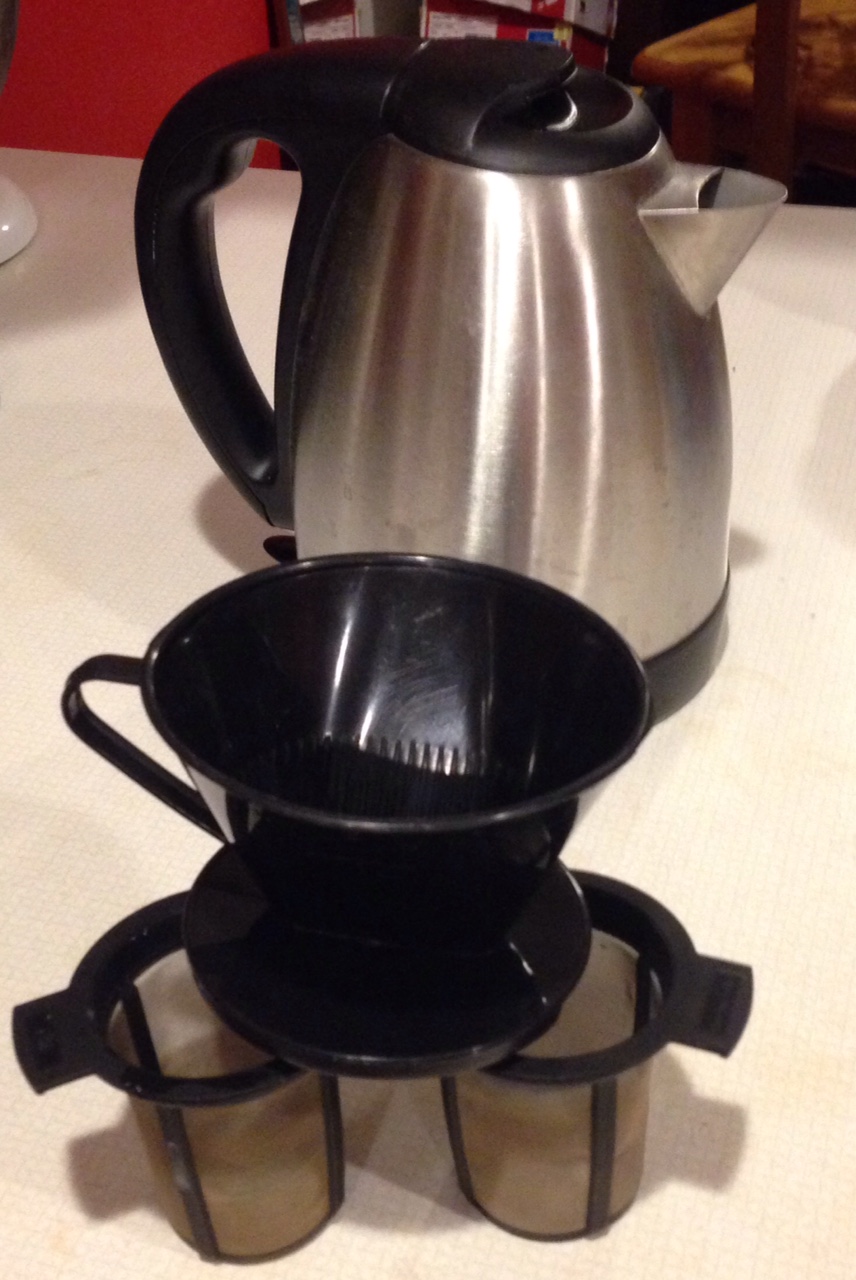
Electric kettle, cone-shaped coffee brewer, tea strainers: aside from cat food, almost everything we need to start the day.

Electric kettle, cone-shaped coffee brewer, tea strainers: aside from cat food, almost everything we need to start the day.
Clearing the Air

Having merged two households, we have a well-appointed home. This is neither brag nor complaint, though if you need a lamp, a bookcase, some coffee mugs, or a digital piano, please visit before you go shopping.

That said, there are a few items that might make life a little more pleasant. We can purée soup or mix milkshakes using a food processor, but a blender would be less messy. We can, if we keep careful watch on the thermometer, use a Dutch oven for deep frying, but there are devices that maintain more precise thermal control. (They might not keep my crab fritters from exploding, as they did when she came to dinner once, but that was the fryer’s fault, not the Fryolator’s.) Using a stockpot, we can, well, can pickles and applesauce and salsa–well, she can can. I’d read the directions a dozen times and still fear we’d end up with botulism nachos. A pressure canner would offer a greater range of preservable recipes, with the side benefit of making pot roast a weeknight dinner possibility, but that hardly makes it a necessity.

What we do need, though, is an industrial strength exhaust fan. The one that’s built into the over-the-range microwave just isn’t doing a good job. I have yet to put a decent sear on a steak without fogging up the kitchen. She came downstairs just as the smoke alarm started to blare its alert. She pressed the reset button, but the alarm kept wailing. “Just take it outside,” I said, thankful it wasn’t hard-wired into the ceiling. As she did, she probably didn’t say, “There, there, it’s all right, he isn’t burning down the house,” but perhaps I didn’t hear her over the ineffective roar of the incumbent fan.

The steak, seared for 30 seconds a side in a very hot skillet, then finished with a brief stay in a blazing oven, was said to be “perfection.” I was glad to get it right–and glad to remember to bring the now-quiet detector back inside after the air cleared, where it stood silent sentry while we slept.

I’m Going to Go Back There Someday

I’ve never been to her favorite restaurant. We’ve talked about it many times, but we haven’t gone there for a meal yet.  It’s a very nice place, she tells me. It’s a place where a meal has a real sense of occasion.

And it’s a place where she went for memorable meals with a person she was once engaged to.

That’s not the biggest reason we haven’t gone to her favorite place. Mostly, it’s because we don’t go out to eat. We visit a restaurant before or after we’ve done something else that we’ve gone out for: to see a show, for instance. Her place isn’t somewhere you go to grab a bite before the show. When we do go there, it will an occasion, not a meal to rush through.  We’ll go there, in part, to create new memories–to reclaim that restaurant for herself, and for us.

We met a friend for dinner last week before a rehearsal. He chose a Japanese restaurant we knew he liked. We liked it, too, and not simply because it was conveniently down the block from the rehearsal space.  We’d gone there after a performance once–with him, and with the woman he was then dating. Subsequently they became engaged, but that relationship recently, suddenly, and very painfully ended.  This was the first time we were seeing him since the breakup.

Dinner was excellent, maybe the best sushi I’ve ever had. The fish was meltingly tender, incredibly fresh, and  perfectly seasoned by the sushi chef.  The addition of extra soy sauce or wasabi was thoroughly unnecessary. I’m glad the food was so good, but I wouldn’t have cared if I’d been served a bowl of Cheerios that had been left out in the rain.

He may chosen the place because of its location, or because he especially likes the food there, but we hope it was because he wanted to reclaim the restaurant as his, rather than theirs. Although the memory of having dinner with a hurting friend isn’t exactly a joyous one, it’s one that we will cherish. We may not always think of this restaurant as the place where he told us what happened, but at least it won’t any longer be the place we went with them.

Breakfast Bolognese

“Could I have a donut and a hard-boiled egg for breakfast?” she asked.

The CSA share included a dozen eggs every week, and with only two of us in the house, we always had eggs around; we kept a half-dozen hard boiled for easy breakfasts. But friends have taken over the CSA share, and our egg supply gradually diminished.  I picked up a dozen after rehearsal.

I knew I forgot to do something when I got home: there were no hard-boiled eggs. There was, however, just about enough time. I put four eggs in a pan of water along with her magical egg timer, and set it to boil.  The eggs were cooked, but, at her departure time, too hot to carry.  I offered a pig-in-a-blanket left over from race-morning brunch, some grapes, and the requested donut. From her reaction, that was an even better choice.

Having scooped out the eggs and timer, I had a pot of just-off-the-boil water. I was just about to pour it down the drain when I remembered the last of a container of bolognese sauce in the fridge.  I liked the idea of conserving resources by re-using the hot water. I put the pot back on the still-warm-but-turned-off stove, salted the water, and poured in some dry pasta. I lidded the  pot, grabbed my keys, and the took the commuter to meet her train. Upon returning from the station, I found a pot of perfectly al dente pasta.

A friend of ours posted to Facebook recently that her son was sulking because he couldn’t have macaroni and cheese for breakfast.  I presume the issue was that there was no macaroni and cheese in the house, rather than some sort of parental concern that it would be an inappropriate breakfast food. I resisted the temptation to heat the sauce and have penne bolognese for breakfast, but only because I would have felt the need to tease our friend about her son’s breakfast request.

Of course, maybe I just did.

Domestic Pas de Deux

Now and again, she gives me an impromptu dance lesson.  It happens as we’re walking along an uncrowded street. She’ll take my hand and raise hers and all of a sudden I’m in mid-spin.  The first dozen or so times this happened, I was as clumsy as could be. I’m getting a little better lately–not so much at the spinning as at recognizing the signs that it’s about to happen.  I hardly ever stumble, and I know she’d catch me were I ever to start to fall. Occasionally, the turn even approximates something dance-like. Sometimes, the lesson is more formal; usually in the kitchen where there’s plenty of floor space for a little waltzing.  We seldom do more than a few one-two-threes, but I haven’t crashed into any furniture or bruised any of her toes. Yet.

She can follow or lead. She’s apparently somewhat in demand in her folk-dancing community, where there seem to be fewer skilled leaders.  I don’t mind following, since she knows what she’s doing and I’m still learning–and I know that both partners in a dance have important roles. She’s a better teacher than I am student, but that’s because I’ve been an accompanist much more often than a dancer. I haven’t quite gotten over my shyness about dancing, but I will.

Fortunately, either of us can lead or follow in the kitchen.  I’ve done most of the leading lately, so I was happy to let her take charge as our holiday continued. She pored over a favorite cookbook and was forming a plan. The object was to make  hearty fare, especially in case we ended up with an unexpected and heartbroken houseguest.  A secondary objective was to use only ingredients that were already on hand. Thus, while happily staying in sous chef position, I suggested against recipes that called for a lamb shoulder, a whole turkey, or a big hunk of beef. Or, for that matter, more than two eggs or the cup of milk that would remain if we reserved enough for this morning’s coffee and tea.

I was a less effective kitchen aide than I could have been, owing to frequent but brief interruptions for chats with our friends in the aftermath of the weekend’s dramatic events. But nothing burned, no knuckles got scraped, and no emergency trips to the market were required. The refrigerator is organized, free of a few items that were unfortunately past their prime and well-stocked for the week. And we dined well.

The skillet rice that is one of her favorite dishes was tasted but otherwise left to cool and packaged for lunches: sausage and sautéed vegetables enveloped in sticky rice, sweet with tomatoes and warm with cumin. Southern Green Beans are nearer to a one-pot meal than a side dish, long and slow-cooked with potato and chicken stock. The recipe called for bacon; we used bacon fat and the last of a stick of pepperoni. It’s not quite the same, but no market runs! Leftover chicken subbed in for a freshly-portioned broiler-fryer; smothered in a mushroom and onion gravy, with timing adjusted to account for the chicken having been cooked already, it was ready in almost no time.  A handful of sautéed turnip greens will be fine accompaniment to a sandwich later today.  The first slices of zucchini bread that may be future breakfasts were a post-dinner treat while we strategized the evening.

Cooking All the Things

Skillet Rice, Southern Green Beans, Smothered Chicken, and Zucchini Bread. The hard part was not eating everything at once.

There was no long walk, as had been originally planned for purposes of errands and exercise.  Instead, the post-half-marathon cross-training consisted of moving furniture and packing some boxes for storage.  A very tall bed (two mattresses atop a foundation, but with no pea tucked beneath) is now in the freshly painted master bedroom, even though new flooring won’t be installed there for another couple of weeks. An improvised padded headboard protects the pretty wall behind it, and the bed’s sturdy cherry frame is dismantled and stowed. The guest room is empty and ready for painting. There’s nothing we don’t really want or need at hand, yet we haven’t put so much away that it appears we’re living in a temporary space.

Lead and follow changed place many times over the course of the day, without tension or stress, as easily as shifting weight from one foot to the other.  A choreographer might have been pleased.  By the end of the long, productive, and restorative day, we certainly were.

Columbus Day

It’s amazing how many things can go differently than expected in a single weekend–late office departures, pharmacy complications, detours and traffic, rain throughout a half-marathon, and much, much more. When a long-expected celebration ended up being called off at the last minute, it was the icing, so to speak, on the wedding cake.

But we are resilient creatures, we humans.  We revise.  We reconsider.  We adjust. We go on. We console our friends. We offer comfort and a place to stay. We know it isn’t enough, but we try.  And when we have done all we can, we say good night and head sadly for home.

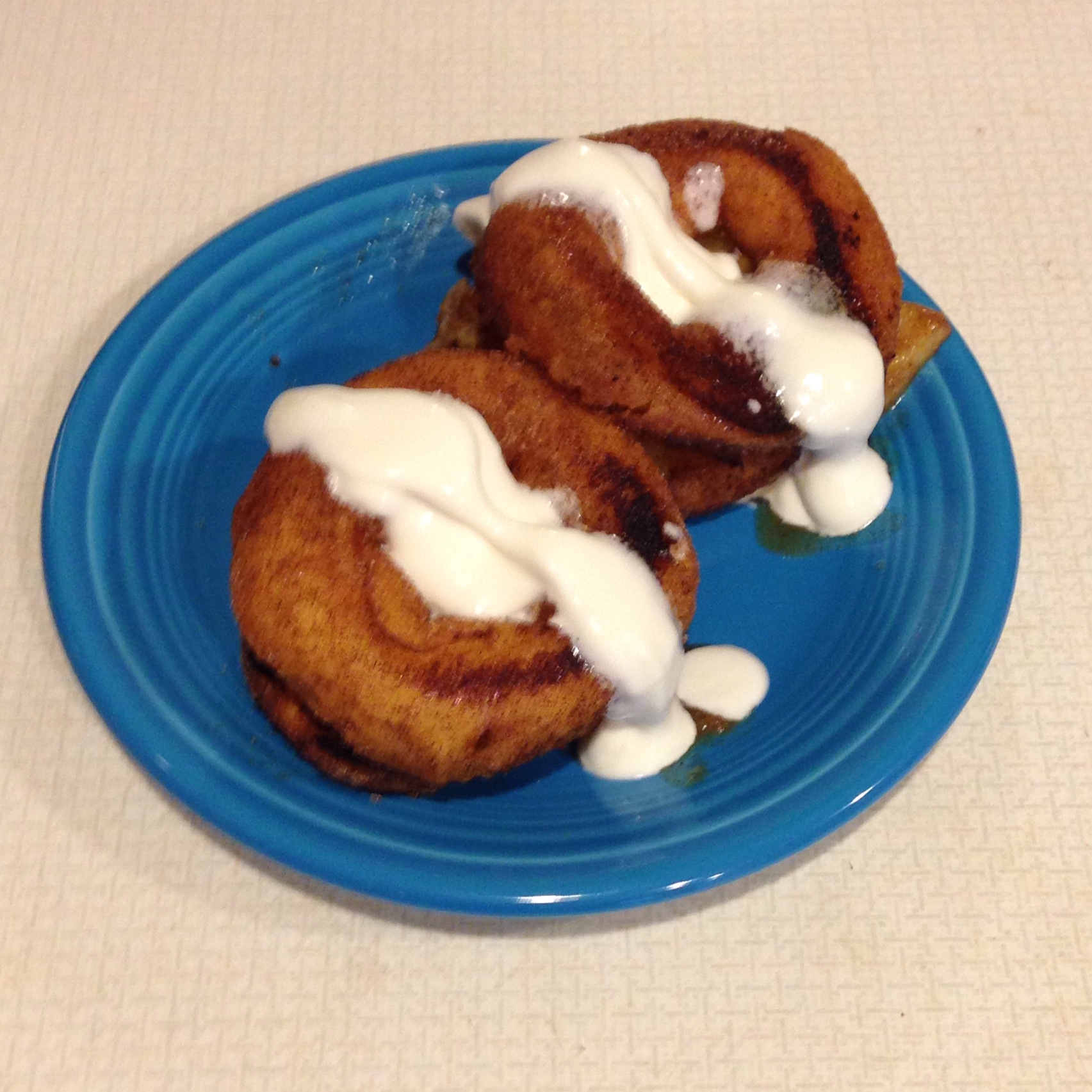
She had brought home perfectly lovely cider donuts from an apple-picking trip with her parents.  But on a cloudy, hard-to-navigate morning, a little extra sweetness seemed appropriate: chopped Macoun and Honeycrisp apples were softened in a tablespoon of melted butter, caramelized with a little brown sugar and dusted with cinnamon and nutmeg. Halves of the donuts, gently warmed and slightly browned in the same pan, were sandwiched with the apples and drizzled with a little whipped cream.

Columbus was looking for a route to India when he found the New World.  We cannot know what world our friends will find in the coming days. The one certainty is that a workday-off due to a civic holiday–and with it a fire in the fireplace and a decadent breakfast–has never come at a more opportune time.

Sometimes donuts are lilies just waiting to be gilded.

Sometimes donuts are lilies just waiting to be gilded.

Road Trip #2

We’re several hours away from beginning an overnight adventure, heading to the state capital for a pair of road races.  Assuming the weather holds, I’ll be running a Half Marathon; she’s entered in the accompanying 5K.  I’d love to be there to cheer for her finish, but–since the races start at the same hour–she’ll be finished while I’m only about a third of the way through the course.  (I owe her one.  Okay, I owe her many.)

The plan is for me to pick her up at the train station after work so we can start our journey right away. It’s a holiday weekend, so the traffic is bound to be thick.  After we arrive and check into our hotel, we’ve got to get to the race registration station to pick up our number bibs for tomorrow morning.  I’d love for us to have a festive dinner at a nice restaurant, but by the time we’re settled, it’ll be late evening, and we’ll be prone to grumpiness or indecisiveness or ordering pizza from whatever place will deliver to our hotel.

Instead, I plan to pack a dine-en-route picnic. I’ll stop at the deli after work and find sandwich fixings: roast beef and something else that looks good (Virginia ham, perhaps, or a Buffalo-spiced turkey.  (Of course, they’ll be cut in half so we can share.)  Provolone cheese, a little muenster.  There’s very fresh lettuce in the crisper, and an assortment of mustards and mayonnaise and horseradish sauce.  Slicing tomatoes are out of season, but that’s probably just as well, as they’d make for very sloppy sandwiches even if I try to wrap them carefully–and I know it won’t be as neatly as she’d do. The object, of course, is to stave off hunger, have something wonderful to eat, and not reach our destination looking like we used our laps for the prep table.

Accompaniments: a baggie of grape tomatoes and sliced red peppers. The best chips I can find. A ginger ale for her, a seltzer for me. There’ll be some chocolate, too, in case we decide not to wait for our destination to source dessert. And moist towelettes.

I will also pack some of her excellent tea and our house-blend coffee for making in our room at the crack of dawn, along with peanut butter and bagels for just-in-case breakfast, and bananas for post-run potassium.

Travel music and fun podcasts on the iPhone. Plastic bags to stow wet running gear. Clothes, of course, but those are already packed.

I still dread the likelihood of a long run on a rainy morning, but the trip and the company will be excellent. Our first grand adventure, long ago, was a road trip to see a musical I’d written. Every trip since has been as much fun, and  this one should be no exception.

A Tale of Three Soups

From her train ride home, she sent a message requesting tomato soup and grilled cheese sandwiches.  I liked the idea instantly, even if it did mean the gravy would have to wait for another day.

We stopped at the market to pick up soup.  They didn’t have any, which was disappointing if not surprising. It’s not a market where you can find everything all the time; it has a great bakery, a garden-fresh produce section, their own coffee roaster, a trustworthy fish counter, and a not-particularly-wide variety of excellent prepared foods, but not aisles and aisle of canned goods. On this day, that not-particularly-wide variety did not include tomato soup. We considered some other dinner options and realized that we did in fact want soup and sandwiches, so moved on to the next-closest supermarket–where our tomato-soup options were nearly limitless.  We chose an organic variety with basil and soy milk instead of cream.

She put the soup in a saucepan, set two cast-iron skillets to heat, and set herself to meticulously prepare sandwiches.  I minced the leftover chicken she wanted to include while she spread molecularly-thin layers of the best mustard and mayonnaise perfectly from crust to crust. I’ve never seen a sandwich made with such precision, much less one I was going to get to eat.

The sandwiches were pressed between the two hot skillets for toasting, the soup was ladled into wide-mouthed mugs for sipping, spooning, or sandwich-dipping, and dinner was served: good soup and wonderful sandwiches. We agreed that the soup was a little bland, more like tomato-flavored soy milk. I heated a little bolognese sauce to be added as we each wished. I know that took the soup out of the realm of simple cream-of-tomato, but I was willing to accept the charge of fussiness.  I suggested that, next time, we make soup from scratch.

She looked incredulous.  “It takes seven hours to make tomato soup.”

I wondered how that was possible. She told me about finding a recipe when she was a girl, and asking the aunt she was visiting to teach her how to cook so as to make it. The good-humored aunt helped her slice many pounds of fresh tomatoes, slow-roast them in an oven for four hours, then skin and seed and dice them and simmer them with stock and gently cooked onions and garlic for another two hours, then puree in a blender, and add sour cream and basil before serving.

I admitted that a roasted-tomato soup was probably better than the one I had in mind, but wasn’t sure it was six hours and fifteen minutes better.

Faster Tomato Soup

2 (1 lb.) cans peeled, no-salt-added tomatoes
1 medium onion
1-1/2 T. butter
1-1/2 T. olive oil
A few basil leaves (or 1 tsp dried)
1/2 cup heavy cream

Set a large saucepan over medium-low heat; add the oil and butter.
Coarsely chop the onion, sauté gently until translucent.
Set a strainer over a large bowl, and drain the juice from the canned tomatoes into it.
Cut each tomato in half, then squeeze gently over the strainer to remove seeds, collecting juice in bowl. Discard seeds. (Or don’t; if you want a little more rustic soup, skip the straining.)
When onion is ready, add tomatoes and juice to saucepan and simmer, covered, about 20 minutes.
Add basil, and salt and pepper to taste, and simmer about 5 minutes more.
Remove from heat and add cream.
Puree, using an immersion blender.
Serve with croutons or, better, grilled cheese sandwiches.

I can’t find her roasted-tomato soup recipe online, and she doesn’t still own the cookbook from which it came.  I believe her, of course, about the long roasting and simmering, but I wonder about investing that much cooking time–especially not with a hot oven in the height of summer when fresh tomatoes are abundant–to get tomato soup. Who knows? Maybe it is that much better. Some night we might consider the relative merits of various grilled cheese sandwich preparation methods, too.  And, maybe, next summer, we’ll have a taste test.

Confidence Gravy

“Do we have any gravy?”

That’s the sort of question you might dread, if the roast turned out to be more well-done than you’d intended.  But that wasn’t the case.  It was 10 PM on a Tuesday and she was in the shower.

“No,” I called back, “but I’m sure I can make some.”

“Right,” she said.  “Because you’re the kind of guy who makes gravy.”

Well, how else would one get gravy?  There are jarred versions sold in stores, I suppose. She had a jar in the City House kitchen for a long while, but I don’t remember what happened to it.

I’m sure I can make some.

I wasn’t sure at all, in fact.  After Sunday’s Chicken Debacle, I wasn’t at all confident about my ability to make toast, much less gravy.  It got me thinking. Gravy was routinely on the dinner table when I was growing up. But somewhere along the line tastes changed, or at least styles of eating did. We have sushi, ratatouille, and sandwiches-on-the-go, but gravy doesn’t happen all the time.  My grandmother and mother could have made gravy without thinking twice about it, but we get it from the supermarket.

Or not.

While Sunday’s chicken was in the oven, I’d cooked the neck and giblets into a saucepan with a cup or two of water, discarded the neck, chopped the giblets and put them aside. I wasn’t sure what to do with them, but it had seemed like the right thing to do.  Once the chicken finally came out of the oven, I reserved and de-fatted the drippings from the roasting pan.  I didn’t dare try to use them at the time; I was happy enough to have food on the table without the possibility of botching a condiment. But it meant that, on Tuesday night, I had in the fridge a ramekin of rich chicken bits and a container of homemade stock. I was most of the way to gravy.

I just had to look up what to do with it.  Something thickens gravy–a roux?  A–what’s that word–a slurry?  Right, that’s it.  (The internet was faster than a cookbook.)

I sautéed some chopped mushrooms in a little olive oil (because: why not?), added the diced giblets to reheat, added most of the stock and brought it to boil. I barely warmed the last quarter-cup of stock and put it into a Mason jar with a tablespoon of all-purpose flour, lidded the jar, and shook it ’til there were no lumps. I added the slurry to the saucepan and whisked.  And magic occurred.  Well, not magic, but gravy. Silky-looking chicken gravy.

In pajamas after her shower, she came to the kitchen to scramble the eggs that would accompany the grits she wanted for her late supper.

“You made gravy!”

I might have grinned a little. “Where would you like it?”

“Oh,” she said. “I was thinking over some of the roasted vegetables for lunch tomorrow.”

Well, of course.  Who puts gravy on scrambled eggs?

Actually, that sounded kind of wonderful.

I put a little egg-and-grits in a tiny bowl, spooned a little gravy over it, and took a taste. It wasn’t the umami-bomb of store-bought, but gentler—not too salty, studded with bits of mushroom and giblets and flecked with a little black pepper. It tasted like home.

I’ll probably screw up dinner again at some point, probably badly enough that we end up ordering pizza.  But tonight, there was gravy.  I’d like to think Mom and Grandma would be proud.  Or maybe they’d just shake their heads and say, “He had to look that up?”


Epilogue: “I don’t need anything for lunch,” she said this morning. “I’ve got things in the office fridge from yesterday.”

Thermal Control

The first Sunday in October was clear and blue-skied.  And more than a little chilly.  It might have been the Christmas-themed movie we finished watching during lunch, or maybe the breeze that had blown away Saturday’s rainclouds, but by late afternoon the yard-clearing was done and we were both thinking thoughts of getting warmer.  We headed for the garden center to buy firewood.

I’ve used pre-packaged firelogs for some years–the sort that are mostly compressed sawdust–and liked their convenience, but not the high cost or chemical smell. Even the “environmentally friendly” versions stunk up the place pretty badly. The garden center offered us a great price on half a cord of seasoned logs, which I hoped meant that they had been left to dry for a long while, and not sprinkled with oregano and cumin. They even keep most of the wood “on file,” so to speak, letting us bring home a few at a time as we choose to. We took one-tenth of our order and headed happily for home, stopping at the market for a few groceries.

The broiler-fryer chickens we’d been looking for were back in stock and on sale.  We bought one and had visions of a lovely evening: a roaring fire and a chicken roasted on a bed of chopped vegetables.

The house smelled delicious, but nothing was quite working.  However much kindling we added, the logs were getting singed but not catching flame.  And dinner was nowhere near ready. At 10 PM, I portioned the chicken, putting the legs and thighs back into the oven and slicing the breast meat for a quick finish in a sauté pan.  The fire was a lost cause.

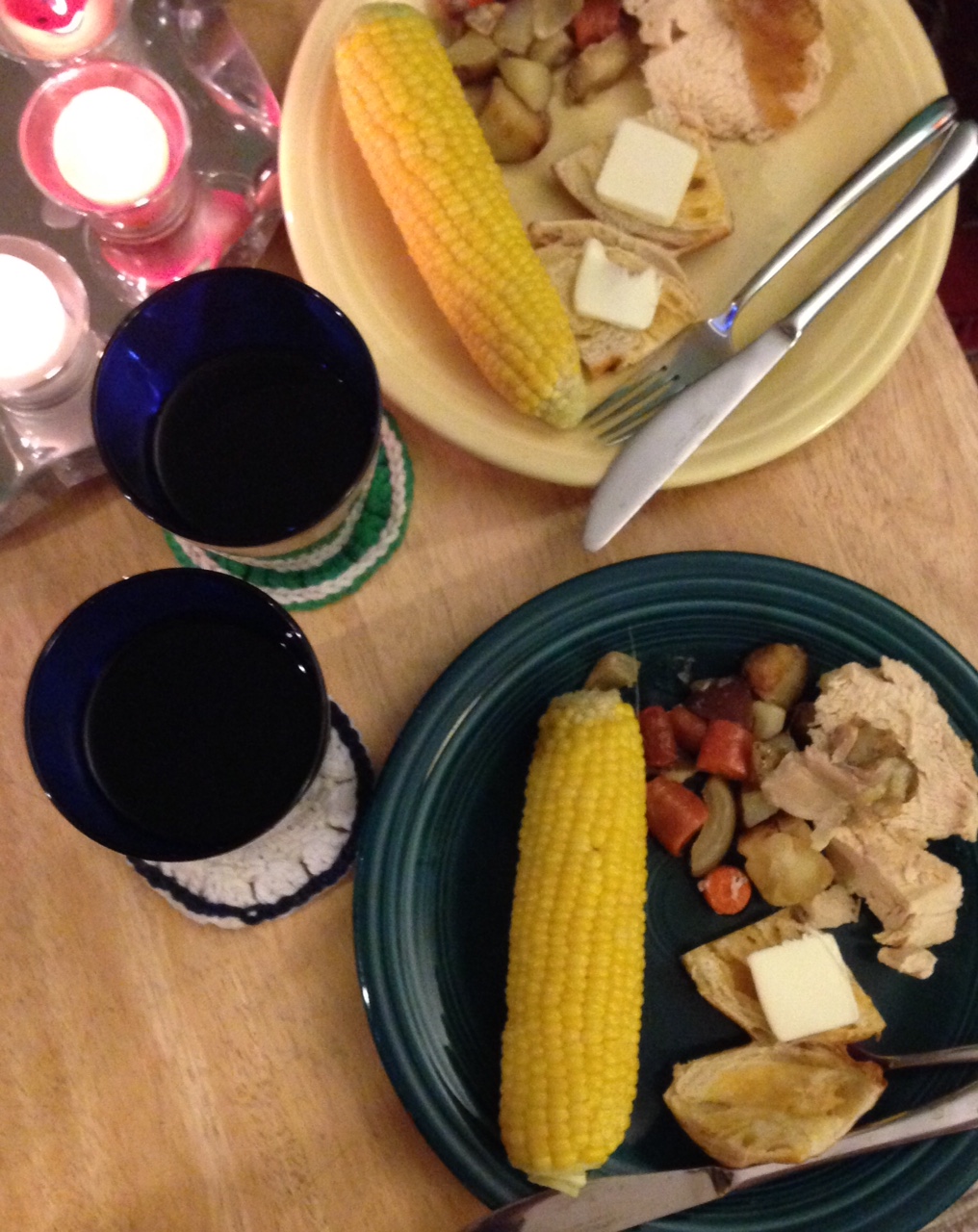
I got fiercely cranky during the whole endeavor–a grown man who can’t build a proper fire or cook a chicken?  Fortunately, only one of us has a meltdown at a time. She tried to lighten my mood, but wisely tempered her efforts when it was clear I wasn’t ready to laugh at the situation. Eventually, with enough edible food to make dinner a viable option, I calmed down. Last-of-the-season corn isn’t as plump-kerneled as earlier ears, but it was deliciously sweet. The vegetables had been abundantly doused with chicken drippings. The chicken itself was tender and flavorful, finally. And pumpkin-spice cake from a recipe she’d found on Pinterest was a sweet and spicy finish, if not necessarily one that will go into heavy rotation in our repertoire.

From now on, we’ll roast chickens that are already portioned, or perhaps learn to butterfly them for faster cooking.  We’ll either start earlier when preparing a big Sunday dinner, or we’ll plan an easier menu.  And, until the logs season a little further and we learn a little more about organizing twigs and newspaper and fatwood, we’ll keep an extra afghan on the sofa.

Last-of-the-season corn isn't as plump-kerneled as the earlier ears, but it was deliciously sweet.  Roasted vegetables had been abundantly doused with chicken drippings. The chicken itself was tender and flavorful, finally.

Last-of-the-season corn isn’t as plump-kerneled as the earlier ears, but it was deliciously sweet. Roasted vegetables had been abundantly doused with chicken drippings. The chicken itself was tender and flavorful, finally.