Including Moderation

Her new phone functioned perfectly on Thursday’s overnight.  Unfortunately, the same could not be said for the rest of the technology her team uses–nor, even more unfortunately, of one of the subcontractors they employ.  She woke from a nap on Friday afternoon to news of an epic failure that might have meant another sleepless night or two.  She was understandably furious.  And maybe a little comically so, but I knew better than to point that out.  Eventually she calmed enough to speak in complete sentences, and reassure us both that we would not incur the expenses of a new laptop computer and additional repairs to the newly painted wall at which she wanted to chuck the old one.  She made herself a mug of tea. A cat settled at her feet, and I left them for a while.

After I returned from a run and showered, I started to bake a batch of brownies.  I wasn’t sure what dinner might be, but thought that after a long night and a terrible afternoon, a little sweetness would be welcome.

While the brownies baked, I started to assemble the last piece of furniture for our office, a cute little rolling cart with many drawers that would hold office supplies and various doodads. She finished her work for the day and came to join me–possibly attracted by the chocolaty goodness wafting from the kitchen.  We worked together happily on the cart (again proving that we pass the Ikea Relationship Test). By the time every Tab A was fitted into every Slot B, every screw was accounted for, and the cart carried to its appointed place in the office, the brownies were ready to cut.

We aren’t doctors or nurses.  We aren’t dieticians. We know perfectly well that brownies are not an appropriate dinner. Except when they are.  We didn’t eat the entire batch, any more than we’d eat the entire Thanksgiving turkey in one sitting. Just one lovely, rich, still-barely-warm brownie each.

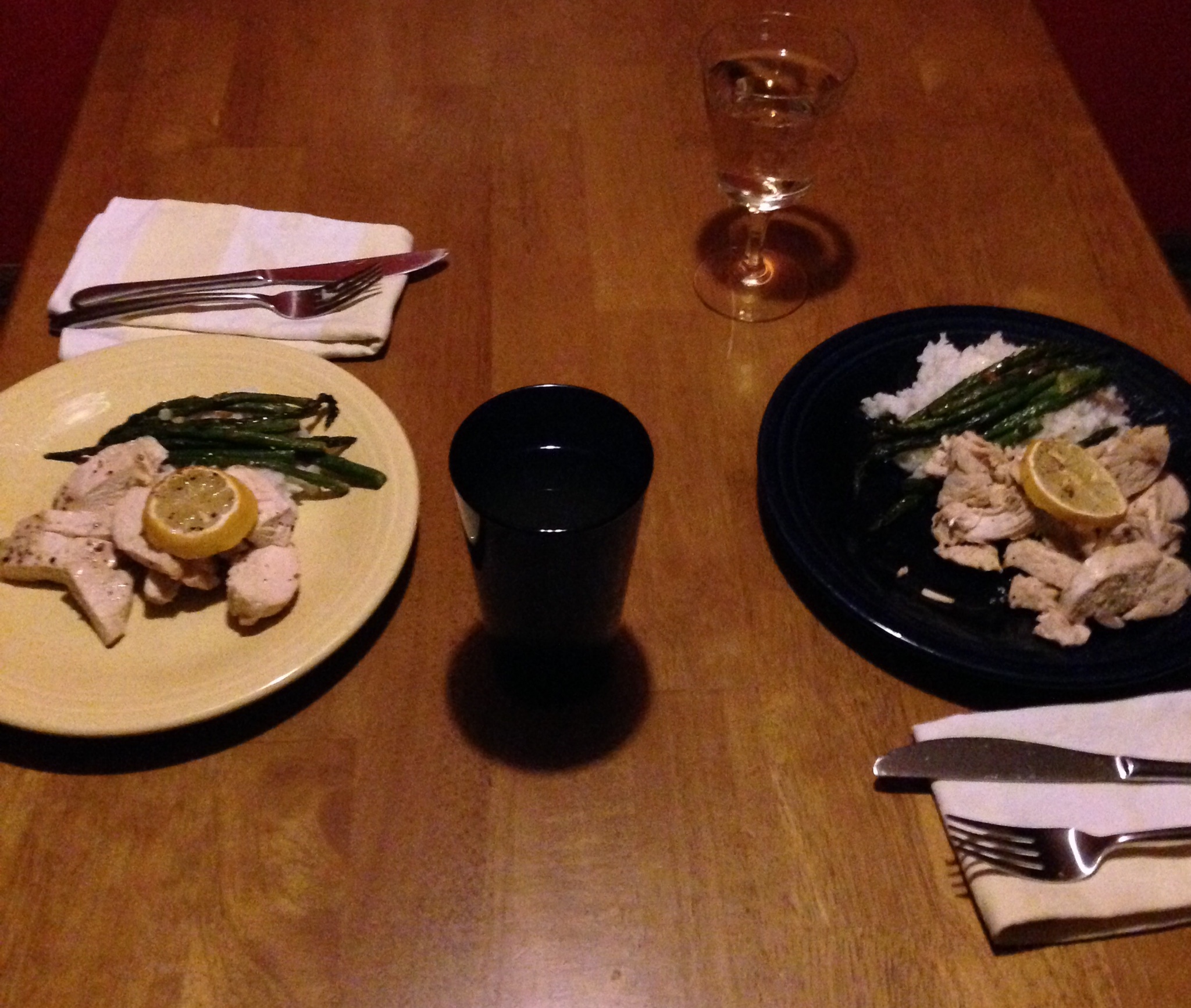
Sunday’s dinner, after her very productive knitting class, my many masses played, and our shared garage clearing, was far more balanced and moderate. She marinated chicken breasts in lemon and olive oil, and served them with sautéed asparagus and rice. Very different from a brownie, but also delicious.

Sometimes there’s a brownie for dinner.  Sometimes there’s a bowl of popcorn. All things in moderation.  Including moderation.

Baked chicken, sautéed asparagus, rice. Nothing immoderate about that.

Baked chicken, sautéed asparagus, rice. Nothing immoderate about that.

A Dash of iPhone

She is not permanently attached to her iPhone, at least no more than I am to mine.  It serves so many functions: alarm clock, camera, runner-tracker-via-GPS, music-and-podcast-and-video player, text-message lifeline, video device, Internet reference library, email handler…and is even, occasionally, used as a telephone.

She knew that her phone’s battery was nearing the end of its usable life. Replacing the battery wasn’t really a viable option, as she’d been rubbing up against the phone’s 16-gigabyte memory limit pretty regularly–especially with the multi-year iMessage stream between us that she didn’t want to part with. We hoped the battery would hold out until January, when her contract permitted her to have a discounted rate on a new phone.

When such a device works perfectly, it is simultaneously thing of beauty and a thing almost not to be noticed: it just works.  When it fails, it needs to be repaired or replaced.  And when such a device fails on the night before arguably the most valuable fund-raising night of her professional year, replacement must be swift and decisive.

“I’m going to buy a new phone after work,” she said, in one of the few messages between us yesterday that reached its recipient before the battery expired again.

“Why not come home, and we can go to the store at the mall?” I replied, thinking that a suburban shopping experience might be a little less crowded and noisy than the Times Square AT&T store on a matinee-day evening.

She agreed. Her phone died again on the way to Grand Central, as we rushed to meet for the earliest train possible. We made it, by seconds and found seats, but seats without power outlets.  No work for her on the ride home.  No knitting, either, she realized; her sweater pattern was stored in her useless phone, too.

I realized we didn’t have to go all the way to the mall, as there are two AT&T stores in our town.  Unfortunately, both closed early. It was just past 8 PM.

“Ridiculous suburbs,” she said, or maybe it was something less refined. I restrained myself from reminding her how much she usually likes it here. We made it to the mall in record time. Knowing stores would close at 9, we raced up the escalators to reach AT&T. While she waited for a Customer Service Representative, I dashed to the nearby Apple Store to find out what was in stock there, just in case.  (She would, it turned out, have her choice of any iPhone she wanted, so long as it was silver and had a 64-gigabite memory capacity.) I nearly bowled over the young man hawking skin-care products from a kiosk between the stores.  Twice.

I returned to her just as she began a conversation with the sales rep–unfailingly politely and cheerfully, as she always is. But she began with the wrong question, and lost a valuable minute-thirty before learning that no phones were in stock there.  “Thank you,” she said sweetly, nearly dragging me out of the store behind her.

The Apple Store was busier, but the Specialist who’d given me the stock report was free soon enough and happy to see me back. She worked through the phone-purchase process as quickly as possible. I was reminded how much faster it used to be, when all you had to do was buy a phone, any phone, and plug it into the wall.  If Mom or Dad had been there, they might have been reminded how the phone company would simply bring the only phone they had and hard-wire it into your house. What Grandma would have thought, I’m not sure.

Once their process was underway, I turned to other errands: since the case she wanted for her new device wasn’t in stock, I purchased her a not-quite military-grade screen protector; I checked to see if the new eyeglass lens I needed had arrived at the optician’s shop; I picked up a piece of nerve-calming chocolate for her at Godiva; and phoned the Perfectly Adequate Mexican Restaurant to make sure they’d still be open to grab take-out on our way home. By the time I finished, the Specialist had installed the protective film, and we made our way to dinner, home, and sleep.

It was not the relaxed Night Before the Big Event that she’d been hoping for, and it wasn’t exactly the season finale of The Amazing Race, but it was full of twists and turns, setbacks, detours, and delays–and a happy ending. She is now the proud (if somewhat poorer) owner of a shiny new phone. Ingrid, as she calls the phone, carries all of her important information for today’s event, all of the photos that are important to her, even her knitting pattern–and, most importantly, has plenty of battery power.

When the Big Event is successfully completed, and after she has had a long nap and shower, I might even ask call her to ask what the name means. Assuming the battery holds out, I’m pretty sure she’ll answer.

Accidental Soup

When we merged kitchens, there were abundances of pantry staples, and far too many duplicate containers. Half a box of salt from one kitchen and three quarters of one from the other found a home together in a labeled glass jar. Baking soda, rice, flour–all into airtight containers, leaving us far less clutter, and a very pretty pantry. Not everything was identical, though, so some things stayed in their original containers; some went into small glass jars. Occasionally, a label didn’t stick, but every system has a couple of kinks to work out.

One night I emptied a cup of hearty looking oats into a dry saucepan to toast them, added three cups of boiling water, lidded the pan, and walked away. Morning came. Coffee and tea were brewed.  Lunches were packed.  She came into the kitchen as I was turning to breakfast. “You made oatmeal!” she said with delight.

I lifted the lid and was puzzled. “I thought I made oatmeal.”

She looked over my shoulder.

“You made barley.”

What I toasted had  looked different than I was used to seeing, but the jar wasn’t labeled, and it was in the oats-jar’s place.  I thought they were the last of a container of ritzy, organic, free-range oats that she’d kept separate from the everyday suburban oats.

I made barley. Dummy!

“It’s okay. I’ll pick up a bagel, and we’ll make soup.”

Saturday night, I chopped and she sweated onion, celery, and carrots in a little oil; beef stock, diced tomatoes, and some water were added, along with leftover pot roast, salt, pepper, bay leaf, oregano, and, yes, barley. In the half hour while everything simmered and the kitchen became warm and fragrant, we did a few chores: mopping up plaster dust that settled after the painter left, preparing cabinet doors to be re-hung.  Just before dinner time, I steamed some chopped kale.  She ladled the soup we hadn’t expected to cook and sprinkled on some parmesan cheese. We dug in.

A friend once told me the story of her young sister, who, while mixing batter, confused vinegar for vanilla.  My friend turned it into a reading lesson and helped her start over.  Another young woman I know mistook one canister for another and baked cookies with salt instead of sugar.  Her boyfriend gobbled them up. They didn’t stay together, but it wasn’t because of the cookies.

Mistakes are made.  What matters is how you correct them. How you recover.  What you learn.  We had accidental soup, and it was wonderful.

Accidental Soup

Not everyone likes kale in her soup, even accidentally.

A Night at the Not-Quite Disco

I don’t travel all that often, but when I do I try to eat something that I can’t get at home–a local specialty.  Jane and Michael Stern’s Roadfood has never steered me wrong; in Minneapolis, for instance, it helped me find the best roast beef sandwich I’ve ever encountered. But asking those you meet is a good idea, too.

Nobody in Fish Creek, Wisconsin, could agree on what one thing I had to eat before I left. Almost nobody, in fact, had any strong opinions at all. “Cheese curd, I guess,” said one fellow. So, when I stopped for lunch during a little sightseeing trip between rehearsals, I saw them on the menu and asked for a serving.  They’re deep-fried bits of cheese (imagine a solid-cheese Cheeto) served with ranch dressing. If that’s how they’re served, that’s how I’m trying them–though after a couple of bites the combination of buttermilk and cheese was dairy overload. I asked for some cocktail sauce and tried not to notice the waiter looking at me as if I’d grown an extra head. (Tomato, lemon, and horseradish were, to me, the perfect foil for the fried cheese, though to look at that combination in print makes me understand why the waiter looked at me strangely.)

This isn’t a story about Wisconsin, though. There will be lots of stories about Wisconsin, but those for other days.

When I told her about the cheese curd, she said, “Oh, poutine!” It turns out that cheese curds aren’t especially local to Wisconsin; they are part of the national dish of Canada. Poutine is a plate of french fried potatoes topped with cheese curds over which brown gravy is ladled. I have no idea who first came up with this idea, but if it was a customer at a restaurant, I suspect the waiter may have given a little eye-roll.

This isn’t a story about Canada, either. (I’m not sure that she’s ever been to Canada, and I’ve only been there a couple of times–and I’ve never ordered poutine when I was.)

It turns out that there are many versions of poutine, and plenty of them don’t involve cheese curds. I am not so closed-minded as to say I will never try the one that involves feta cheese and vinaigrette dressing, but it’s not high on my list of enthusiasm.

A particularly swanky version of poutine is served at one of her favorite restaurants. Not her favorite spot; as discussed previously, that is not a spot for a pre-theatre bite. Seeing A. R. Gurney’s Love Letters with Alan Alda and Candice Bergen–our Friday night plan–was a bit of an occasion, so we decided to go her fancy poutine spot.  If our history was any indication, drinks and appetizers would be plenty for dinner.

On Wednesday, as we walked to the train station after work, we realized that it was going to be late enough that we should have dinner before boarding. But not fries, she said. “No, that’s for Friday,” I agreed. “And surely not Disco Fries,” she said. I laughed, trying to imagine fries in a white polyester suit, doing the Hustle under a mirror ball. “You know, American poutine,” she said, and I laughed all the harder her name for the American diner version of a Canadian dish.

We ended up at a diner, with an omelette and a BLT and a chocolate shake in a glass as big as her head–but not Disco Fries.  Which were actually on the menu.  I thought it was a very amusing coincidence until, meeting for coffee with a collaborator at a different diner, I saw Disco Fries listed there, too.

She laughed harder than I had at the thought the she had invented the name.  (She maintains she isn’t that clever, though I know better.) In the Northeast, fries with cheese and gravy are called Disco Fries, though I can’t find an explanation why. Even in this regional variation no sources agree what kind of cheese or gravy is supposed to be used.

Nios’s variation is as lavish as I had been led to understand: excellent fries with shredded mozzarella and julienned strips of pepperoni, sprinkled with chopped parsley, set under a broiler to melt the cheese and crisp the pepperoni, then bathed (but not soaked) with beefy gravy that most decidedly did not come from a can. Salty, crunchy, and rich; with a little salad alongside, and very well-made cocktails, it was a perfect pre-show dinner.

I’ll try Canadian poutine when I have a chance, and I might even take her for cheese curd next time we’re in Wisconsin.  Until then, when fries, cheese, and gravy meet, it will be at Nios. With no disco music.


Divide and Encourage

It takes about eight minutes to get to the train station in the morning, and they’re often my favorite eight minutes of the day.  We’re up, awake, and ready to face the world.  It’s time for a quick conversation about a story we’ve heard on Morning Edition, or a strategy session about the day to come. Of course, plans change, but it’s good to have a start.

“You’re having dinner with Rachel on Monday, right?” I asked her.

No, it turns out not.  She’s meeting her colleague for a drink after work on Tuesday, when I work late anyway. “But how would you like…”, she began, describing a performance organized by some of her other colleagues on Monday.

I hardly ever decline an invitation to the theatre, but a friend had sent me a first-thing-in-the-morning email offering a ticket to a concert in which he’s playing. It will be the first time he’s going to be all dressed up in a theatre where he expected his wedding to take place. Although he didn’t mention it that way, I knew it would be a little strange for him to be back there.

I didn’t have to say another word. “You should be there to support him,” she said.

“And you go to support your kids,” I said.

“It’ll be odd to be in different theaters,” I started to say. “Wait, no, it won’t.  It’ll be like, we own the theatre district!”  We laughed, and arrived at the train station in time for a quick kiss goodbye and confirmation of our meeting time tonight.

Of course we don’t own the theatre district.  Sometimes we’re very peripheral to it, and to the work done there.  But it’s nice to think we can both provide support where it’s needed, even when we aren’t together. We show up.  It’s what we do. For each other, and for our friends.

There won’t be Dinner at the Country House on Monday. There’ll probably be a couple of slices of pizza, purchased from different shops, and eaten on the way to different theatres. Or maybe there won’t even be time for that.  Maybe dinner will be pretzels and soda after the shows.  We’ll meet at Grand Central to share a train ride home, and have plenty of time to talk about our very different, very similar days.

Assembly Required

Making a pot roast is easy, really, especially for two–one to chop the vegetables, one to brown the beef and vegetables and add the flavorful liquid. The sous chef’s duties may also include removing the smoke alarm from the kitchen, but that isn’t the case in every household.

Building furniture is more challenging. Heck, finding the right furniture is more challenging.

Now that the floors and walls in our Writers’ Room are finished and quite lovely, we decided that I should have a proper desk rather than balancing a musical keyboard on two plastic file bins with a jerry-rigged typing keyboard tray beneath it and a metal cart to hold a computer monitor behind.

I found a desk online that seemed perfect in every way except cost–after paying for the floors and walls, a thirteen-hundred-dollar piece of recording furniture that I’d never even touched was risky and extravagant.  She ventured to Ikea in hope of finding something we could customize to my needs, and returned with a carful of boxes containing an assortment of possibilities. She also brought a new desk for herself. (She hasn’t felt like her laptop has a real home–that is, when it isn’t on her lap.)

While the pot roast braised, we opened boxes, sorted parts, deciphered pictographic instructions, fitted Tab A into Slot B, and tried to remain patient with ourselves and each other. The challenge was increased by the latening hour, the knowledge that the laundry wasn’t finished, and that a long week stretched ahead of us. It seemed possible that we were about to disprove our belief that only one of us melts down at a time.

When a timer beeped to let us know dinner was ready, a break was declared. The pot roast was hearty and moist, the vegetables tender and sweet. Served with a little cranberry juice and ginger ale, we were fortified.  We set another timer as we resumed our work: we were going to finish the project in 30 minutes or leave it for another day.

27 minutes later, not a spare dowel or screw was left over. Her desk was beautiful, functional, and sturdy. The table portion of mine was assembled; the gathering and placing of electronic equipment was Monday’s project, and the return of unused components would happen later in the week. I’m not sure if I’m more impressed that we completed the tasks without undue fussing or that she actually knew the proper name of ubiquitous metal Ikea-furniture-connectors: camlock.)

Ikea once made a video pitting a couple of long-standing and a pair who’d only been dating a short while in a race to see who could assemble a piece of their furniture more quickly and successfully. One of the participants said, at the finish, “IKEA is like love. The instructions aren’t always clear. Sometimes you think you are doing it wrong but at the end of the day, you’ve built a desk together.” We’ve known each other a very long time, but the our current relationship status is relatively new; I don’t know, really, which side of that relationship test we belong on.

We built a desk. (Two of them, in fact.)

Her desk is ready for a laptop and a pad, with a cozy rocking chair for reading, or waiting patiently while a collaborator finishes a new scene or song.

Her desk is ready for a laptop and a pad, with a cozy rocking chair for reading, or waiting patiently while a collaborator finishes a new scene or song.

His desk is still a work in progress, but everything fits. Let the composing begin!

His desk is still a work in progress, but everything fits. Let the composing begin!

The Best Sauce

It has been one of those weeks.

For a project with “dinner” in the title, there has been a whole lot of no-dinner-cooking at the Country House.

I missed a train on Monday–by moments!–and so had to drive into New York in order to get to a meeting.  She met me after, and we drove home together, but by the time we arrived, nobody much wanted dinner. (It could have gone entirely the other way; we might have wanted all the food there was, and then some.)

We both worked late on Tuesday, and had had late lunches; again, no dinner-making.

Wednesday was a theatre night; last weekend, I realized that she’d never seen a long-running musical written by two friends of mine, so we went to see it; we met for a bite on the way. I took a photo of our dinner, but the meal hardly seemed like writing about. The food was fine; the show was delightful.

She worked really late on Thursday in order to take a train that arrived just in time for me to meet her after choir rehearsal. I made us a snack to eat while watching a little TV before bedtime, but it wasn’t a real meal.

On the way to a slightly-later-than-usual train this morning–which she’d decided to take after working late four days in a row–we decided that we were going to stay in this evening.  No theatre, no movies, no trips to furniture stores, no visiting friends; a night at home. She asked for “something light.” I’m glad I asked her to be more specific; given that direction, I might have made a big green salad. She had in mind some white fish; perhaps some rice; and maybe green beans or asparagus. It sounded like a plan to me, so I stopped at the market on the way to meet her evening train.

The menu was her idea, so she started cooking.  (Also, I couldn’t do much in the way of meal prep, since she had me sticking my head under a towel with a bowl of steaming water and herbs to clear a stuffy nose. I was, however, able to look up fish-baking time on my iPhone.)

30 minutes at 375ºF later, there were two perfectly-baked tilapia filets, each topped with a sprinkling of Old Bay seasoning and a lemon slice.  There was a pot of nutty rice, fragrant with thyme. There was a hot skillet, into which barely-steamed asparagus had been tossed with a little olive oil, garlic, salt, pepper, and a squeeze of lemon.  Fancier than a peanut butter sandwich or a bowl of ramen noodles, but it seemed not at all elaborate. It was just right.

Or maybe we were just hungry.

It’s said that hunger is the best sauce, but that doesn’t necessarily mean a physical need for food; the best sauce might be the desire to have a quiet dinner at home, at a decent hour, with some pleasant music playing, and the best possible company.

We cleaned our plates.

Tilapia, rice, asparagus. A glass of juice. Nothing more is required.

Tilapia, rice, asparagus. A glass of juice. Nothing more is required.

Babycakes

On a Friday night not long ago, we’d been looking forward to watching the PBS broadcast of a theatre production that featured some people we know. Unfortunately, she fell asleep on the couch before the show started.  I puttered around on the internet for a while, surprised at how many programs PBS made available as streaming video.  A series of short cooking videos called Kitchen Vignettes caught my attention. Beautifully shot and set to lovely music, they were educational, though there was no voice explaining the recipes being demonstrated.

I was especially intrigued by one called “Groaning Cake.” I wasn’t sure what sort of cake might groan, but the soundtrack–a recording by the folk singer Heather Kelday–held me. I learned from the text displayed in the video, that Groaning Cake is a traditional postpartum food.  It’s a very rich, calorie-dense spice cake made with whole wheat flour, carrots, zucchini, and apples.  It might even be considered healthy, save for the great deal of butter, the many eggs, and the gobs of honey and molasses.

In the video, a woman is shown baking the cake. She’s very pregnant, a fact which the filmmaker apparently wants us not to forget for a second.  Every shot that isn’t a closeup of ingredients going into a bowl is of her swollen belly or breasts. In the last moments of the video, we see the beautiful child, and a fellow who is likely the father; then the new mother feeds her partner the first slice of cake.

That’s where they lost me.

The idea seems to be that a new mother will have neither the time nor energy to cook after giving birth, so this cake would keep her fed while she regains her strength. If I followed the timeline, the woman baked the cake, gave birth, and then fed the cake to the guy. Was he not capable of turning on the oven, grating some zucchini, and measuring the cinnamon and cloves? Was he, at the very least, not up to the task of cutting a slice of cake for the mother of his child?

Maybe it’s all the breakfasts I’ve made and lunches I’ve packed, but it just seems fair that she would get the first bite. Of course, what do I know? I’m not a father. Maybe standing around while someone else does all the really hard work is harder than it seems. A guy can probably burn a lot of calories by pacing.

Friends of ours recently had a baby–a beautiful son. Of course we had a bear to give to the new baby; every child should have a good, sturdy bear to keep him company. But we thought we should do something more.

We baked them a Groaning Cake.

The cake takes its name from a woman’s cries during labor–which, some say, is induced by the preparation of the cake.  Somewhere around the third stick of butter (or maybe the fourth egg, or the half-a-jar of honey) I began to think the name had another meaning: when I felt how heavy the pan of batter was, I may have let out an involuntary grunt. At least I didn’t spill it on the way to the oven.

On Sunday afternoon, we wrapped up the cake and went to visit the proud parents and meet the baby. It tasted as swooningly good as it had smelled while baking (a fact I learned after the new mama got the first bite). It was also, it turned out, slightly underdone. It wasn’t hazardously soggy, but it is likely that I added too much of the apple-carrot-zucchini trifecta, and the batter was simply too moist to ever fully set.

The new mom and dad were too sleep-deprived to notice any baking issues. The baby was happy, calm, and snuggly–and he wasn’t going to get any cake, anyway. At least not today.

There aren’t any babies at the Country House.  It would be a nice place to raise a child, but it’s too far away from her office, and from where much of my theatrical work is, to be practical. We’d spend all of our time commuting and either never see the little one, or never see each other. That might change one day, but for now, we try to be good and loving examples to the children in our friends’ lives.

And if it does change, you can bet that she won’t have to bake her own cake.

The Second- or Third-Best-Laid Plans

Our plans began, as is so often the case, with an iMessage.

I know what to make for dinner! Mulligatawny Soup.  It’s usually served over rice, but crumbled cornbread will also do.

I was driving when the message came in, so I didn’t respond right away. I like her Mulligatawny Soup, rich with chicken, peppers, and spices, and thick with rice. I started trying to remember how many of the ingredients we had on hand.  When I arrived at the station to meet her train, our conversation didn’t go straight to food, though if it had, I might have said, “Mulligatawny is a good idea, but I could really go for a pile of vegetables, a little protein, and maybe a dinner roll.”

We headed off to the very large home improvement store to purchase electrical supplies. Her parents were arriving the next morning for a visit; her dad, a skilled electrician, was going to teach us how to install new electrical outlets. By the time we’d found everything on our shopping list, neither of us was in the mood for going to the market, much less cooking afterward.

“Let’s go out,” she said. “But to a place where it’s okay to be dressed like I am.” I was in dark jeans, a sweater, and a tweed jacket. She had worn jeans and a blouse to the office, and looked good enough to get into any restaurant I’d want to go to.

At a traffic light, the plans amended again. “We could just get take-out…”

We cruised slowly down Route 1, neither of us quite sure what would be on the menu. A favorite casual Italian place presented itself, and we stopped. And the plan amended again. “While we’re waiting for our entrees, let’s have a drink and an appetizer.”

“You’re going to laugh at me,” she said, looking up from the menu. (Plans were apparently changing again.) “Instead of a full meal, why don’t we share some appetizers and a salad?” I would never laugh at a girl who doesn’t particularly like vegetables ordering a salad. We considered the merits of the salad she had in mind, and settled instead on a sampler of appetizers–a few meatballs, a few chicken wings, and some breaded mozzarella–and a platter of roasted vegetables. We placed our order, and, as we sipped our drinks and toasted the good fortune of friends who’d just had a child, the waiter appeared with a bread basket.

It was my turn to smile. We had started by thinking about mulligatawny soup and ended up with a pile of vegetables, a little protein, and maybe a dinner roll. And we were both delighted with the evening.

Yes, And

“Are you making beef with broccoli?” she asked, sounding equal parts amazed and teasing.

I like vegetables.  Broccoli probably comes in third in my list of favorites, behind brussels sprouts, which are coming into season and filling me with delight and anticipation, and green beans, for which I think the USDA’s recommended serving size ought to be, “Well, how many have you got?”

The thing is, I wasn’t making beef with broccoli. I wasn’t sure what I was making, though.

We’d both worked late, and she was feeling in the mood for something bland, so she was heating a bowl of mashed potatoes to have with butter, salt, and pepper. I was foraging. I’d found a little piece of rare beef and some rice; the latter, topped with a damp paper towel, would go into the microwave when her potatoes were done.  The rice wouldn’t be as good as it had been when freshly cooked, but far from terrible. I figured I’d thinly slice the steak and sauté it quickly in a little olive oil, slice a few grape tomatoes and toss those into the pan, too, and then pour it all over the reheated rice.  Maybe add a little salsa.  Maybe grate some cheese over the top.  It could be vaguely Tex-Mex. It was sort of a plan, but not quite.

There wasn’t anything green, though, and I think dinner should almost always include something green.  But I didn’t feel like assembling a salad. There were some broccoli florets, though. They got a quick steaming along with the rice, then went into the hot pan to brown on their tips, along with a generous splash of teriyaki sauce and a dab of minced garlic. Everything topped the rice, and the lot was garnished with a sprinkle of sesame seeds.

Meanwhile, she discovered to her horror that we were out of butter. “You can check in the freezer,” I said, “but I’m afraid there’s none there.” She opened the door and proved me right. But there was a little bag in the top compartment of the door containing small blocks of frozen cream. (She’d needed a very small amount for a recipe last winter. Not wanting to waste, we froze the rest in an ice cube tray and have been using it, a little at a time, ever since.) “Defrost one of these,” I suggested; “It’ll add some creaminess.” Instead, she pulled an empty pint-sized jar from the cupboard. “No!” she said.  “I’ll make butter!”

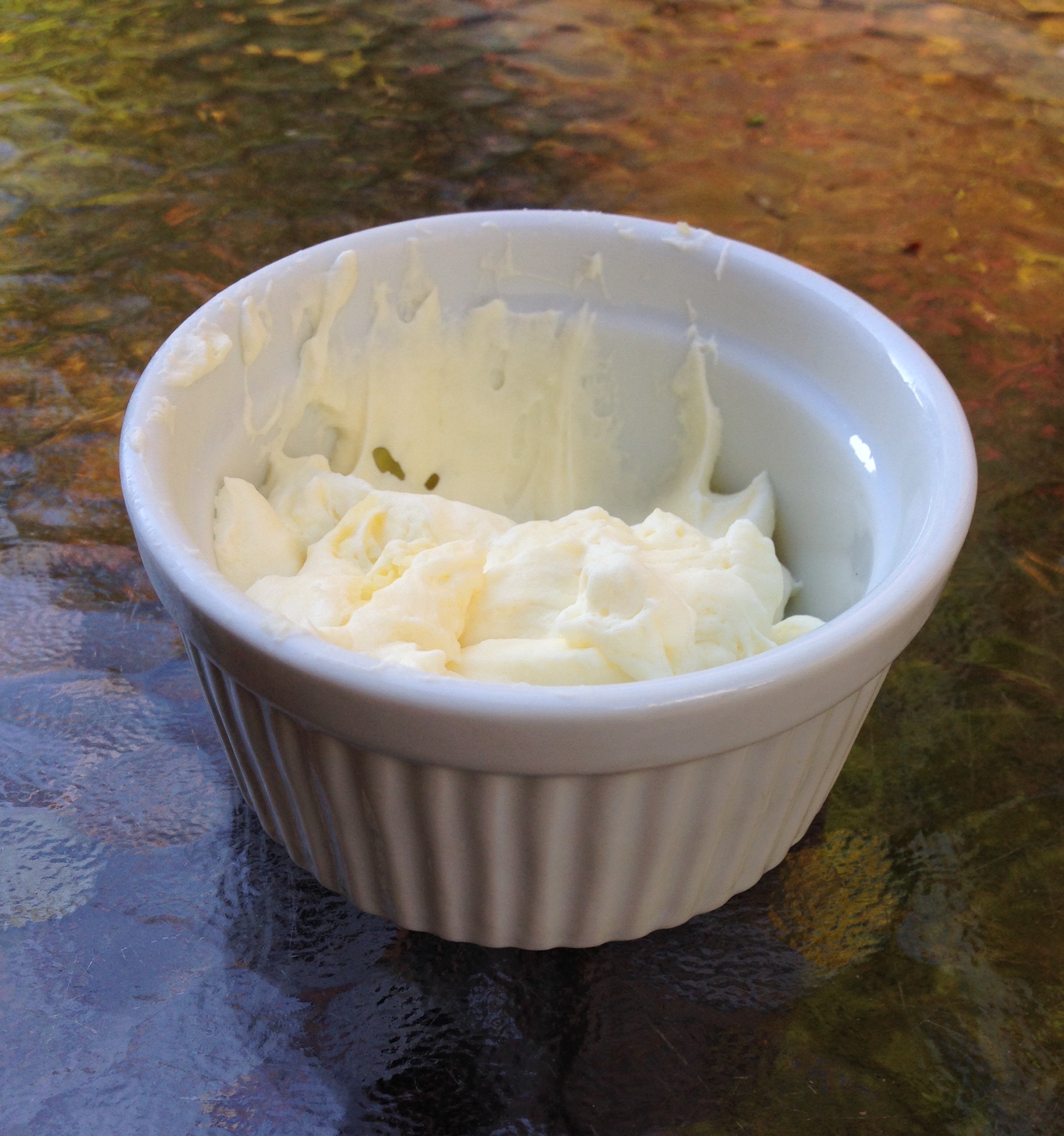
She thawed the cream and put it in the tightly-lidded jar, then danced about the kitchen, singing and shaking her jar of cream like a maraca. After a couple of minutes, she stopped, disappointed that her jar wasn’t really well-suited for churning butter or adding percussion to a vocal arrangement.  She poured the only-barely-clotted milk into the bowl of her Kitchen Aid mixer, and sent it to whisk. 8 minutes or so later, she had a ramekin of soft, lovely butter. I don’t think we’ll give up buying it in sticks from the grocery, but it’s nice to know that it’s an option.

The first rule of improvisational theatre is “Never say no.” If you’re playing a doctor in a scene and another character enters saying her car won’t start, you can’t object that you’re not a mechanic. You accept the given information and go forward.  “Yes, and I’ll bring my stethoscope to listen to its carburetor,” you might say. If you’re “enjoying” the sunshine and your scene partner says it’s raining, it’s not “No,” it’s “Yes, and now I get to use my new umbrella.” If you’re rocking your “new baby” and a new character compliments your rhinoceros, “Yes, and she has her mother’s horn.”

Yes, and…

“Are you making beef with broccoli?”

Yes, and would you pass me the soy sauce?

“Oh, no, we’re out of butter!”

Yes, and we have cream and a powerful mixer, and we can give ourselves a science lesson.

“We have to clear the guest room for the painter, and there’s nowhere to put the extra bed!”

Yes, and we can stack one mattress on top of another, and put a pea under the bottom one to see if we can feel it!

You can call it improvisation, and the result is sometimes funny, but really, it’s just two people being as creative and generous and kind as they know how. And a little bit more.

I’m going to be a contestant on a game show tonight–a live theatre presentation, not the TV kind.  The object for me and my partner–my partner whom I’ve never met, of course–will be to write a song on a randomly assigned topic, in a randomly selected musical style. For a musical. In twenty minutes.

You might think, “Well, they did that in real time on TV,” but the music on Whose Line is it Anyway? was pre-determined. Also, those comedians weren’t writing for musical theatre characters, or being judged by writers and directors. I’m a little nervous about this event–about not finishing on time, or that the style won’t be one I’m comfortable with, or that our song won’t be as funny as the other team’s. (Though “funny” isn’t one of the prerequisites, it’s probably better in a game like this to be funny than heartfelt). I don’t mind losing, but I want to do well.

Fortunately, I have lots of improvisational experience on which to draw. And, win or lose, she’ll be in the audience, and we’ll have dinner after the show, and then go home to a very tall bed. Victory could not not be sweeter than knowing that.

Or home-churned butter.
Butter