Author Archives: Her

How to Make a Flavored Gin Fizz

Rhubarb-infused gin makes a lovely pink cocktail.

Fruit-flavored cocktails are all the rage, but there are two hurdles for the home bartender to surpass in making them:

  • Infusing fruit into a sugar syrup is easy, but in trying to balance the fruit flavor against the alcohol you run the risk of oversweetening the cocktail.
  • Flavored alcohols are pricy, and it’s hard to use up a whole bottle if you’re mixing for just one or two people at a time.

An excellent work-around for both issues is to flavor your own at home, in small batches. It’s an excellent way to eke out the last bit of use from overripe fruit, too!

Earlier this month I made rhubarb gin from the last of my home grown rhubarb.

  1. Wash and dry the stalks, and trim them into ½ inch pieces.
  2. Place the cut rhubarb in a glass jar, and cover with gin. (We stock Tanqueray London Dry at home.)
  3. Lid the jar and tuck into the back of the fridge for a couple of weeks.

On Saturday, I strained the solids from the liquids and we were left with a lovely pink liquor. We mixed it with a bit of lemon juice and a dash of vanilla syrup, and topped off the glass with ginger soda for an easy, flavorful, and not-too-sweet Rhubarb-Ginger Gin Fizz.

Have you ever made your own flavored alcohol?

Simpaug Farms CSA: Week One

Three-quarters of today’s haul. 

It’s my favorite day of the summer: open season at our CSA! Earlier this morning I collected the contents of our crate – three cloth sacks full of gorgeous greens, with dirt still on the radishes – and then spent the afternoon cleaning and trimming and drying and storing all of it. Because I’m a crazy person, and that’s what the first day of the season is all about.

My plan is to catalog what we receive each week, and to note our plans for cooking, eating, and preserving it. So, let’s get started.

What’s In This Week’s Share: Week One

Vegetables

  • Broccoli – 16 ounces
    Storage Instructions: Mist the unwashed heads, wrap loosely in paper towels, and refrigerate. Use within 2 to 3 days.
  • Snap Peas – 16 ounces
    Store in a plastic bag in the refrigerator. Use within 5 days.
  • Spicy mixed salad greens – 8 ounces
    Store loosely in a plastic bag in the fridge; use within 5 days
  • Rainbow Chard – 8 ounces
    Store in an air-tight plastic bag with as much air removed as possible, for up to five days
  • Red Leaf Lettuce – 10 ounces
    Line a food storage container with paper towels; separate the leaves and place them in the container, wrap loosely with paper towels, and place in the crisper drawer – check daily to discard any spoiled leaves; will keep for a week
  • Squash – 32 ounces
    Refrigerate in a perforated plastic bag for up to a week
  • Pointed cabbage – 24 ounces
    Store in the crisper drawer for up to a week
  • Kale – 10 ounces
    Wrap in paper towels, store in a zip-top bag in the refrigerator
  • Fennel – one 3.5-oz bulb
    Store in a plastic bag in the fridge for up to 10 days
  • French Radishes – 7 ounces
    Top and Tail the radishes, place them in a mason jar of cold water, and store them in the fridge. Change the water daily.
  • Scallions – 5.5 ounces
    Store in a quart-sized mason jar with the white bottoms submerged. Change the water daily, and they will continue to grow.
  • Garlic Scapes – 10
    I store them loose in the crisper drawer and trim the cut ends weekly; they keep for months

Other

  • Eggs – one dozen

What To Make With This Week’s Share

I’ve ordered the list of produce in order of perishability, so that governs how we’ll consume it.

Frozen Stir Fry Mix
This is a super-busy week for Clay, and my parents are in town for the week to work on a big house project. We won’t have a lot of time for big cooking projects, so I’m taking a short-cut and creating two family-sized packages of stir fry vegetables to freeze for easy weeknight dinners for July. They will include:

  • Broccoli
  • Snap Peas
  • Onions and Carrots from the pantry

When it’s time to make the stir-fry, we’ll add in a fresh bell pepper and all of our seasonings, and serve it over rice or noodles.

Chopped and ready for a Mandarin Chicken stir-fry

Salad
I bought a bag of the farm’s spicy mixed greens last week, and we made a splendid salad. We’ll repeat that pattern this week, with the

  • Spicy Mix
  • French Radishes (roasted with carrots then sliced into coins)
  • Yellow Squash (peeled into slender ribbons)
  • Green Pepper and Grape Tomatoes from the market

We’ll mix the fresh veggies with a big batch of creamy Green Goddess dressing made with our homemade yogurt, fresh lemon, and the GG salad mix from Penzey’s. It should yield four servings as a meal or eight as a side.

Radishes in a jar if fresh, cold water.

Pork Tenderloin with Braised Chard and Roasted Fennel
When I think about pork sausage I smell fennel and rich earthy greens, so we’ll create a whole meal around those flavors. We’ll use:

  • A pork tenderloin from the freezer
  • Rainbow Chard
  • Scallions
  • Fennel
  • Garlic Scapes

I’ll chop up one of the scapes and stuff it into deep slashes in the pork, to impart a lovely garlicky flavor during the roasting process. We’ll quarter the fennel bulb and roast it in the same pan with the pork, and braise the chard with a few of the scallions and another of the garlic scapes.

Fennel Bulbs remind me of woven carpets.

Vegetable Lasagna
I made a fabulous vegetable lasagna for Easter that I’d like to reprise – one-third of a box of lasagna noodles in a loaf pan makes a solid meal for four with leftovers. We’ll use:

  • Kale, chopped very finely
  • Scallions, chopped
  • One Garlic Scape, puréed
  • Two Zucchini, sliced into very thin coins
  • Shredded Chicken, Basil Pesto, Tomato Sauce, and a variety of cheeses from our freezer/fridge/pantry.

Coleslaw
Clay’s favorite summer condiment is coleslaw, so he’ll use ingredients from our pantry and a couple of carrots to turn the Pointed Cabbage into his favorite treat. (Then he’ll probably make pulled pork to go along with it.)

Breakfast BLTs
To power us all through a week of construction work at the house, I’m counting on bottomless pots of coffee and tea, and a hearty breakfast to start each day. We’ll make bacon and egg sandwiches on fresh bread, spread with a tomato pesto and topped with the red leaf lettuce for crunch.

And that should take us through the week. Stay tuned for how it goes!

How a CSA Serves Us


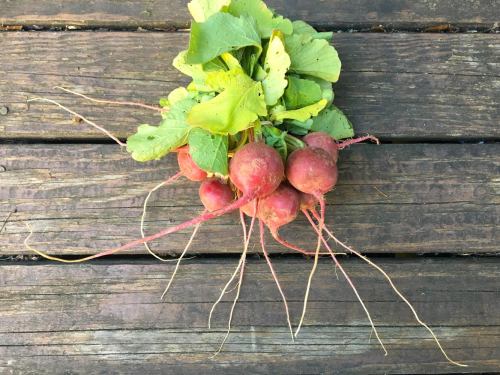
radishes

Simpaug Farms radishes – June 17, 2018

Over the past few weeks, I’ve written about how we’ve evolved in our cooking and shopping habits since combining our kitchens, and how we save money at the supermarket in order to have more to spend on delicious little splurges. But there’s one other major way that we both save money on food and splurge for the very best: our membership in a CSA.

CSA is short for Community Supported Agriculture, and it’s a brilliant business model for small farms to support the communities that exist in the areas surrounding the farmland. There’s been risk involved with farming since the first farmer planted the first seed, but CSA removes some of the risks from farming by allowing the people who eat the food to purchase it before it’s grown. (I did say it was brilliant!)

Our local farm is Simpaug Farms in Suffield, Connecticut. Nestled on 250 acres – that’s a bit less than half of a square mile – the folks who run the farm use sustainable practices that preserve the land the generations to come, they produce fruits and vegetables free from synthetic pesticides, and they raise animals without hormones or antibiotics. They plant a broad array of fruits and vegetables that come into peak ripeness throughout the season, ensuring both variety and abundance for members.

We joined the Simpaug Farms CSA back in April, by filling out a form online and making a payment of $800. In return, starting on June 19 and running for the next 20 weeks, we will collect a crate of 10 to 14 different fruits and vegetables, and a carton of a dozen eggs. That works to roughly $35 per week for produce and $5 per week for eggs – all of it local, natural, hormone- and antibiotic-free, and chosen just for us at the peak of fresh deliciousness. (For comparison, at the grocery store yesterday we spent $26 for half that volume of fruits and vegetables from at least several hundred miles away, and $5.99 for a dozen similarly raised eggs.)

This is clearly a wonderful partnership for me and Clay, but it’s just as wonderful for the farm. I met Megan and Max, who run the business-side of Simpaug Farms, at the Fairfield Farmer’s Market this morning. Max’s answer to my question “So how does having the CSA help the farm?“ is excerpted below.

The biggest form of help from the CSA is being able to plan better. Today, which is just a day at the Farmer’s Market, started at 5am. We drove from the office in Ridgefield to the farm in Suffield, collected all of the produce from yesterday’s harvest, drove to Fairfield and set up the market, are working here to sell everything we can (and hoping we guessed right on what to bring), and later we’ll drive back to the farm to drop off anything we don’t sell so it can be put to use.

With the CSA, we know in advance how many people will collect their shares from each location, so know just how much to pack and deliver. But when CSA members purchase shares early in the season, we can plan just how much of a crop to plant because we can adjust for our market. Since the biggest costs in farming come early in the season with seeds and equipment, it’s really helpful to have the capital for that up front, too.

There are still shares available for the Simpaug Farms CSA, and the first pickups for the season start on June 19. Join us in supporting a fabulous small farm, and in eating well all season!

P.S. If you want to get to know a little more about the farm and the CSA, their pinterest boards are full of recipes and tips for preparing fresh summer vegetables, and their YouTube channel has some good videos, too.

How We Shop for (and Save Money on) Groceries

Back in January, he referenced the various rebate and shopping list apps I use to save us money on groceries in a post about cheesecake, with a request that I write up the list. Five months later, here we are.

First of all, a note on how we cook and shop. We don’t “meal plan” in the way that most budget- and time-conscious publications suggest. Instead, we keep our kitchen/larder/pantry well-stocked with dry goods that have naturally lengthy shelf lives and use them along with fresh produce, meats, and dairy to compile meals. When consuming the food we’ve brought into the house, we use the ripest (and likeliest to spoil) ingredients first, much like farmers harvesting their most delicate crops.

Since most of our dry goods have a long shelf-life, and since we aren’t so picky that failing to have a beloved treat on hand is a catastrophe, we rarely “run out” of an item we like to have on hand without warning. As a result, we have the luxury of buying groceries when we want to – meaning when we can get the best value for our money. My process is designed around that premise.

First, make note of what we need.

Running low on olive oil? Looking to try a recipe requiring a new ingredient? Add it to the list.

We share a login for the Buy Me A Pie shopping list app, so that we can both see the list of what we need at home when we’re on the go. It syncs in real time, which is a huge plus.

Second, review what’s available on sale.

We receive grocery stores circulars for our favorite shops in the mail on Thursday, so page through them to look for sale prices for anything on our “need” list, and also to look for what’s fresh and available this week. Is the best fish counter offering wild-caught salmon filets? Add them to the list for Saturday’s supper. Is his favorite pastrami on special at the deli? We could use a pound for sandwiches during the work week. We add items we like from the circulars into the grocery list app.

Third, review what’s available for rebate.

We use four different apps that offer rebates for purchasing specific items from specific stores. Just like with the circulars, I flip through the offers in each app to find…

  1. Is something on our need/wish list available for rebate? If so, claim the rebate in-app.
  2. Is something we would ordinarily buy and have room to stock available for a rebate? If so, claim the rebate in-app and add the item to the grocery list.
  3. If we are in need of rounding out fresh food supplies for the week (produce, meat, dairy) are there items in those departments that are appealing? If so, claim the rebates in-app and add the items to the grocery list.

Fourth, shop.

We head to the market(s), collecting the items on the list as we go, using apps to verify product selections as necessary. We check out as per usual, but take extra care to ensure receipts are legible and tucking them safely away.

Fifth, claim rebates and rewards.

After unloading groceries the from the car, it’s time to claim the rebates.

Each app works a little differently, but in general I open each app and use it to take a photo of the receipt, and then scan barcodes on the items I’m claiming to verify the products purchased.

In each case, unless otherwise explicitly stated, a rebate available in multiple apps can be claimed in each app and rebates apply even when paired with an in-store sale or manufacturer’s coupon – provided that the receipt shows some amount paid for the item in question.

List of Rebate Apps

These are the apps that I use.

  • iBotta (that’s my referral link; if you use it to sign up and collect your first rebate within 7 days of doing so, we both earn bonus rewards). Ibotta has the broadest selection of items at the broadest selection of stores, and not just for groceries. The company pays all rebates in a cash transfer via PayPal or Venmo. 
  • Checkout 51. The rebates available are for items and brands found in most large supermarkets. There is a small selection of rebates available, but it changes every week on Thursday. The company pays all rebates by check mailed to the address on file with your account. 
  • SavingStar – Like Checkout51, SavingStar offers a small selection of rebates on items found in most supermarkets, but from a wide selection of stores. If a store offers a loyalty program, you link the app to your loyalty account, activate rebates within the app, and then swipe your loyalty card as normal at the check-out – rebates are then automatically applied to your Saving Star account. The company pays all rebates in a cash transfer via PayPal. 
  • Fetch (My referral code is D5BPU , and using it gives us both a 2,000 point bonus after you submit your first receipt.) Unlike the other apps, Fetch only accepts receipts from supermarkets and grocery stores, but there is a “scanning bonus” – you earn 25 points for every receipt you scan from a major chain retailer even if there are no rebates earned. While the other apps are product specific in their rebates, Fetch is brand specific – you earn a percentage of the purchase price for every item tied to a participating brand. Fetch rewards are accrued in points rather than cash, and are paid out in electronic gift cards. 

So, how do you save money on groceries? I’d love to know your methods – and please let me know if you try any of mine!

P.S. Apart from apps that offer specific rebates for specific items, there are also apps that pay you for snapping photos of your receipts. ReceiptHog pays out in cash via PayPal, and ReceiptPal pays out via electronic gift card.

How We Share a Kitchen

We first started this blog almost four years ago, when we combined kitchens into a single household and began our life together. Since we both loved to cook and eat, with pretty divergent styles, our thought was to document* our culinary adventures and see how we changed and grew. In the intervening years, we’ve fallen into a steady rhythm of habit and circumstance for how we stock our pantry, how we shop for ingredients, and how we cook – and it isn’t at all what we imagined when we began!

Once upon a time, I was a rigidly predictable home cook. Meals were planned in accordance with recipes from cookbooks and blogs, based on a relatively consistent and small list of staple ingredients and fresh produce. Shopping was done on the same day each week with a visit to the farmer’s market and the nearby grocery store, holding to a modest budget with enough room for the occasional splurge like a beautiful cut of steak. Wasting food was a cardinal sin, so cooking well was a duty as well as a pleasure.

By contrast, he was an “anything goes” sort of cook. Whatever ingredients were on hand were turned into meals, and if that occasionally meant cold cereal with sliced fruit for dinner, then so be it. Shopping was a haphazard thing, with trips to the market made whenever an item was needed, to purchase whatever looked appetizing – particularly if it was on sale. He’s more playful and adventurous than I, firmly believing that “if it’s awful, we’ll just order a pizza.”

As you can imagine, marrying those styles took some concerted effort, so we let circumstance give us a little push toward what seemed easy. Given that I have a longer commute and more rigid schedule during the week, he does most of the cooking – which means it’s generally improvisational in nature. I take responsibility for keeping the kitchen well stocked and generally tidy, which means the freezer is full and the larder is overflowing.

Since he has driven me to be more adventurous while retaining cost consciousness, we make a lot of our food from scratch – it’s less expensive to buy incredible ingredients and turn them into sauces and garnishes than it is to buy tiny jars of dreamy extravagance, so this allows us to eat better quality food than we could otherwise afford to. For us, cooking “from scratch” includes:

  • Making our own specialty dairy items like yogurt, sour cream, clotted cream, and ice cream from milk, cream, and butter sourced locally
  • Baking our own yeast breads using whey, a by-product of making yogurt, to give our loaves added flavor
  • Baking quick breads, muffins, cakes, and pies at home
  • Keeping whole spices on hand and grating or grinding them to create our own blends
  • Allotting freezer space for gallon-sized bags of shrimp shells, poultry carcasses, beef/lamb/pork bones, and vegetable peelings – to make broth from whole ingredients rather than bouillon
  • Creating sauces as part of meal prep from those spices and stocks and a whole new set of must-have pantry staples
  • Saving overripe fruit by pureeing it for yogurt stir-ins, smoothies, sauces, or home-made ice cream/sorbet

…and a whole lot of other things I’m likely forgetting.

I’m not the only one who’s changed, though. While still an improvisational cook, he will share ideas for specific meals a day or two in advance, so I have time to think them through and suggest additions or alterations. While he prefers not to eat the same meal several days running like I will, we save leftovers in the fridge as “pre-cooked ingredients for the next meal”, such that rice, chicken, vegetables, and peanut sauce from last night’s stir-fry might be used in rice pudding, chicken pot pie, pasta primavera, and hummus (respectively) – and he focuses on using leftovers first, so as not to waste things.

Speaking of waste, we also subscribe to a local composting service; they collect our kitchen scraps and leave us a fresh locking pail each week, and we can purchase finished compost from them when needed.

Although we’ve ordered plenty of pizzas—especially since discovering a favorite place has opened a new location between our train station and home—it’s never been because of a disaster in the kitchen.


*We had to document something. Since our first meeting was over livejournal in 2003, and since we fell in love so gradually over email and iMessage that we didn’t even notice it, a failure to continue our epistolary adventures might be the undoing of us!

Salsa for Canning: The Veg Box Chronicles

We’ve been steadily plugging away at using our CSA produce, but now that we’re approaching peak harvest, the volume is increasing faster than a family of two can chew. Given how the stressors of life earlier this summer led to some wasted veggies, my “we can’t waste anything” attitude has become a little more militant – so I’ve been mentally dividing our weekly hauls into four categories:

  • Foods that are best eaten fresh (eggplant, yellow squash)
  • Foods that can last for awhile (carrots, onions)
  • Foods that can be frozen with a little effort (berries, zucchini (shredded))
  • Foods that can be preserved with a lot of effort (tomatoes, tomatillos, peppers, etc)

We’ve been roasting the “best fresh” foods and eating them with so many different grilled proteins and slow cooked grains, that my tummy is always full of yums. (The current favorite is brunch: slice an assortment of squash-like veggies and onions, arrange them on a cookie sheet a generous sprinkle of salt, and roast for an hour or more until they are fully caramelized – then pile them onto cheesy grits and top with an egg.)

We’ve been cycling through what can last for awhile, including the grocer’s sack of carrots. The first harvested are pulled from the bag and included in almost every meal – peeled as “noodles” under a stir-fry, shredded in cole slaw or salad, chopped as a mirepoix base for an adaptation of our favorite Instapot chili, quick-pickled to eat alongside bratwurst, and baked into a delicious frosted cake.

We’ve divided the “good frozen” foods into best-for-baking portions, and stocked the freezer with enough ingredients to keep us in quick breads for two months: so far we have 1 cup measures of shredded and drained zucchini and whole blueberries, and I’m looking forward to drying apples in the fall.

Yesterday, we turned the tomatoes, tomatillos, green peppers, cubanelles (in place of the called-for jalapenos,) garlic, and onions from this week’s box – along with some cilantro and a few extra toms to make up the right volume – into a gallon of salsa that we preserved for winter use.

Some of my most vivid childhood memories are standing on a chair at the kitchen counter of my grandmother’s house, the youngest of the “old enough” cousins tasked with preparing vegetables for canning. We shelled peas, snapped beans, peeled the skins off tomatoes, cut corn from the cob, and ate as we went – while avoiding the splash of boiling liquids from different hot pots on the stovetop. I don’t have a family recipe for tomato salsa, and I don’t believe anyone ever made a tomatillo variety, so I try new ones every year.

Having had some luck with a few of Mel’s recipes earlier in the season, we opted for her Best Homemade Salsa for Canning recipe, halving it for the volume of ripe tomatoes we had on hand. Seasoning to taste, we used half as much sugar as she did, and double the amounts of cumin and cilantro. I’ll try this recipe again, but will roast the garlic first – the overall recipe has a beautiful blended flavor, but biting into a mince of mostly raw garlic is a little over sharp. Using 5 cups of tomatoes and adjusting the other quantities to match yielded us four pint jars and a small bowlful for yesterday’s lunch.

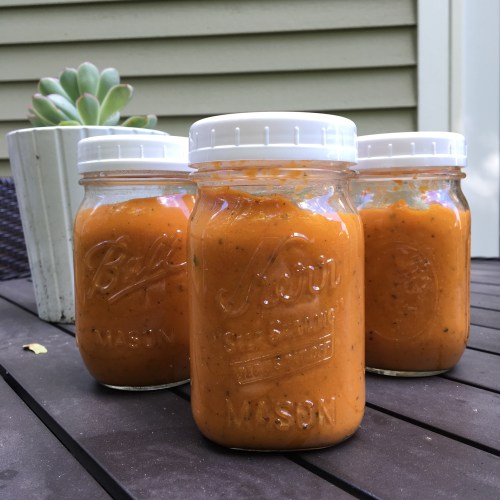
Having never made tomatillo salsa, I found a well-reviewed recipe from Food.com, and gave it a whirl. We had 7-1/2 cups of tomatillos, so adjusted the other quantities accordingly for a yield of 3 pint jars, 2 half-pint jars, and a small bowlful for lunch.

Modifications: at the end of the 20-minute simmer the liquid was too lemony for our taste, so we added a tablespoon of sugar and more cumin, then let it cook for another 10 minutes before adding a palmful of cilantro and giving the whole pot a whizz with the immersion blender to turn it into a much smoother consistency. Next time, I’ll cut the lemon juice by 1/3, too (or sub in a little distilled vinegar if needed for the proper preserving PH).

We have plenty of salsa for the winter plus a few jars for gifts, and a day of remembering childhood – for $14 at the grocery store, and one week’s vegetable box. That’s quite a yield.

The eyes have it

So I made this carrot-tomato soup over the weekend, and we enjoyed it for dinner on Monday – along with grilled cheese sandwiches and a green salad. Fine, fine comfort food that seemed worth a review.

I couldn't get the texture smooth enough in the food processor, so he whirled an immersion blender through the last of it in the pot to remove lumps and bumps. The soup is very thick, even though I subbed in cream for the yogurt (since ours was still in the machine at finishing time), but beautifully spiced with basil, cracked black pepper, and the cumin-seasoned roasted veg.

If we hadn't been eating cheese-stuffed sandwiches along with (provolone, cheddar, and cranberry Wensleydale inside pumpernickel), I would have sprinkled shaved or crumbled cheddar over the soup as a mix-in, for a little sharpness over the top of the rest. As it was, the soup a great dipping consistency for our sandwiches.

I would make this again, albeit with a bit of something green thrown in – Garlic scapes, or some shredded cooked spinach – for a bit of contrast, and a bit of stock for thinning it out. And I can imagine tossing in a bit of roasted turnip, parsnip, beet, or potato when those come in season.

Do you have a favorite puréed or other root vegetable soup recipe?

My Family’s Favorite* Pickles


A jar of our Fave Dill Pickles, before delivering them to a friend on Saturday night.

Some of my earliest memories as a little kid are from the vegetable garden at my grandparents’ house. It seemed as large as a football field to me, and when our shadows started to get long in the grass, Gram would lead us cousins down the rows with an enormous colander.  We would pluck beans, peas, zucchini, yellow squash, cucumbers, and tomato for dinner – filling our tummies more quickly than the dinner basket, which was a great strategy to keep us from complaining of hunger.

My relatives preserved their own food the whole time I was growing up. Fresh food that we grew ourselves was tastier (and cheaper) than store-bought, so the pressure canners got passed around and everyone had a large collection of long-used and well-loved mason jars that got passed from house to house. I remember my mom carrying jar after jar of corn scraped fresh from the cob with small, bright pieces of red pepper down the stairs to our cellar while I sat at the kitchen table, well out of her way.

When I moved to the city on my own, I took on the work of hot-water-bath canning high acid foods on my own – sourced from pick-your-own orchards and farms, or the generous overflow from my hobby-farming uncles. By this point I’ve put up hundreds if not thousands of pints of tomato sauce, salsa fresca, spiced applesauce, apple butter, fruit jams, and sour dill pickles. The pickles are my absolute favorite.

I couldn’t tell you whose recipe this was to start with, but it’s pretty simple:

  • The night before canning begins, scrub your pickling cucumbers to remove dirt and the spiny growths from the nubbly outer skins. Toss the washed cukes into a colander in the fridge to dry.
  • The morning of canning, prep your cukes:
    • Slice off both ends
    • Sort the vegetables by size, and practice stuffing an empty jar, so you know how many of each size will fit into your jars.
  • Set up the hot water bath and sterilize jars, lids, and rings. While they are sterilizing,
  • Make a brine and bring it to a boil, following these ratios:
    • 1 cup of vinegar
    • 1 cup of water
    • 1 tbsp kosher salt
    • 1-1/2 tsp granulated sugar
  • Prep your seasonings. For each jar:
    • 1 head of fresh dill or 2 tsp of dried dill seeds
    • 1/2 tsp mustard seeds
    • 1 clove of garlic, peeled but whole
  • Once the jars are sterilized, remove them from the canner. Into each jar, place the seasonings, then the cucumbers, then ladle in the hot brine (leaving 1/2 inch of headroom). Seal the jars and dump them back in the water bath for 10 minutes. Let cool, check the lids for a vacuum seal, label with the date, and place them into a cool dark cupboard to mellow for at least six weeks.


*If I’m 100% honest I’ll admit that most of the family prefer sweet bread-and-butter pickles to the dill ones. I despise those fake pickles, so am calling these the favorites. 

Pendulums Swing: The Veg Box Chronicles

Last week I wrote that we hadn’t done much cooking or eating in two weeks. We have more than made up for that lack in the last week!

  • Last Monday, we cleaned out the fridge of as much about-to-be-too-far-past-prime-for-eating produce as we could for the Salmon Feta Soba Salad.
  • Tuesday we had dinner with friends in town and came home too late to do much with our veg box other than tuck it into the fridge. It contained:
    • 3 pints of Blueberries
    • 1 head of Cabbage
    • 3 pounds of Carrots
    • 20 pickling Cucumbers
    • 8 small Eggplants
    • 2 heads of Leaf Lettuce
    • 1 enormous bunch of Parsley
    • 3 green Peppers
    • 8 summer Squashes
  • Wednesday was a lovely night for cooking.
    • I combined two-thirds of the carrots with some onions and garlic from our pantry and roasted them for a carrot-tomato soup.
    • He used all of the Peppers plus most of the Eggplants and Squashes (plus onions and tomatoes from the pantry) to make a Disney-inspired Ratatouille., served over grits with a fried egg for dinner.
  • Thursday was a late night for him, so I enjoyed left-overs and started the annual summer scrubbing of the kitchen cabinets.
  • Friday was for preserving.
    • I turned the 2 largest Cucumbers into Amy Pennington’s sesame quick pickles and preserved the rest as my family’s Favorite Dill Pickles (3 beautiful pint jars of them).
    • While a set of salmon filets were grilling away outside, he tossed the last of the prior week’s Romano Beans into the pressure cooker as an adaptation of this recipe from the New York Times – and they remind me of a stewed tomato and french bean dish my grandmother used to serve when I was a little girl.
  • Saturday we went to a dinner party, bringing a jar of those lovely pickles as a hostess gift, and a tray of hoisin-glazed grilled shrimp for the appetizers.
  • Yesterday I assembled the carrot-tomato soup from Wednesday night’s carrot roast, made a tart from the prior week’s pint of Sour Cherries and the last handful of blueberries (plus one of the bags we froze on Tuesday night) – while he made a salad with the last of the prior week’s Kale, Friday’s quick pickles, and some peppers, tomatoes, and herbs to go with a grilled steak for dinner, and did all of the work for more homemade yogurt.

Sadly, the parsley did not survive its overnight in the fridge without water, but the cabbage has been reserved for a batch of coleslaw – we’ll make it tonight to have with pulled pork on Friday – and the lettuces are washed and dressed for bag lunch sandwiches this week. We still have some eggplant, squash, and carrots, along with some potatoes from the prior week. I’m hoping that the Potatoes will become Hasselbacks to go with next Friday’s dinner, and that the Eggplant will become a lovely dip to take with lunch as an afternoon snack. Carrots last for a while so I’m not worried about those, but I am fast out of ideas for Squash.

What have you been cooking? What would you do with 4 little summer squashes that aren’t zucchini?

Sweetening Sorrow

Our beautiful, loving, feisty old girl left us forever last week. We miss her dreadfully, but are grateful that she's no longer in pain.

Part of grieving our friend has meant not eating very well (or very much), and being not at all creative with food. Last week's CSA delivery included pickling cucumbers that have not yet been pickled, squashes that have not yet been squashed, and lots of kale and lettuces that have been chopped and added to dishes that have gone mostly uneaten. We've pledged to take better care of ourselves this week, and have already started by drinking some of our nutrients, via smoothies.

I'm not much of a health foodie. Juice bars are not my thing. But I love milkshakes and things resembling them – like Starbucks frappucino. He's a bit more conscious of feeding me good-for-you ingredients than just milk + ice + fruit purée, so has been experimenting with ingredient combinations. Today's train-ride take-along is a tangy, tart-sweet blend of:

  • Banana
  • Pineapple
  • Strawberry-Rhubarb Jam (homemade)
  • Greek Yogurt (homemade)
  • Honey
  • Ice

After some trial and error, we found that fruit purée is a more reliable punch of flavor than whole fruit chunks, so I made up two bottles* of it on Sunday night.

Fruit Purée (adapted from Giada De Laurentis' recipe)

  1. Make a ginger-rosemary simple syrup: combine 3 tbsp chopped ginger, 1 cup of sugar, and 1 cup of water in a saucepan over medium heat. Stir until every grain of sugar has dissolved and the liquid is clear. Remove from heat, add a 3" sprig of rosemary to the pot, cover, and let stand until cool. Strain the solids, reserving the liquid in a jar.
  2. Place 3/8 cup of ginger-rosemary syrup in a food processor with a pound of fresh fruit. (I used strawberries and pineapple.) Pulse until beautifully smooth; ladle into jars.

It took more time to wash the food processor (twice) than it did to make the purées, and they feel like decadent ingredients. Totally worth it.

* He claims that getting the purée out of slender-necked bottles is more trouble than it's worth. Next time I'll store it in jars.