Author Archives: Him

Attention Must Be Paid

She’d asked for a bagel with cream cheese to take for breakfast.  Nothing fancy. Her go-to breakfast. “With a slice of tomato, if we have any?” she asked hopefully. I knew we had tomato.

A cheddar bagel looked interesting. I sliced and toasted it, smeared on some cream cheese, added the requested tomato, sprinkled on a little salt and pepper, and crumbled on a slice of bacon. Because when there’s bacon in the fridge, why not? I wrapped the sandwich in a cloth napkin to absorb condensation and secured it in a Ziploc to keep from making a mess, tucked it into her bag and sent her off to work.

This text message came when she got to her office and opened the package:

How could you have possibly known exactly what I needed to feel human – even when I didn’t?

She’s given to hyperbole, I know. But still–“exactly what I needed to feel human”?  I was following the motto of our favorite spice shop: “Love people, cook them tasty food.”

We all need food to “feel human.” Why shouldn’t it be as good as it can be? I was just paying attention.  She prefers savory bagels to sweet ones. (I’m pretty much the opposite, at least for breakfast bagels. But then, I’m given to understatement rather than hyperbole.) Any minute now, fresh tomatoes will disappear, except for the flavorless tomato-shaped water balloons at the supermarket, so it makes sense to add tomato to a bagel while we can. The bacon, though, was just a little surprise. I know she likes bacon, too. Just paying attention, like she does for me: among many other things, this life-long tea drinker has developed terrific coffee-making skills.

I got it wrong last night, though.  I forgot that, in her world, fruit does not go on ice cream. She spooned the offending plums into my bowl and, I’m pretty sure, forgave me.

A Side of Snobbishness

Friends of mine are working on a new musical, and the only chance I had to see it was on Wednesday night.  The theatre is a long trip, almost twice as far as it is to NYC, but it’s a pretty drive to a charming town and a lovely theatre that does bold, interesting, innovative work.  So, even though it meant that chicken I roasted was the last Dinner at the Country House since Sunday, I headed northeast.

A few years ago, this theatre produced a show I co-wrote; one night after a performance, our director took my collaborator and me to a local pub for dinner. Now, I try to leave time for dinner at this pub every time I go to that theatre. I honestly don’t remember what main I ordered on that first trip; it’s a side dish that stuck with me. Cottage Fries are round slices of potato, so named because they vaguely resemble the shingles that might tile a cottage roof. These are mandoline-sliced, ridged rather than with flat sides. They’re heavily spiced, with very crisp exteriors and a tender center; I suspect deep frying.

Most Cottage Fries recipes I’ve found call for oven-frying with a long baking time.  These are, I’m pretty sure, deep fried.  My writing partner, who found them so tasty as to be addictive, referred to them as Crack Fries.  I doubt there is any illicit substance in the seasoning blend; I taste cayenne, salt, and paprika, and they’re served with a dipping sauce that includes dill, leeks, and sour cream–but who knows what else is in there?  The Harp and Dragon isn’t telling.

I met a friend for dinner before the show–of course, at the Harp and Dragon, and, of course, I ordered the Cottage Fries to share. She’s a theatre professor at a relatively-nearby college. She told me of a particularly disheartening master class that had been given for her students by two theatre professionals.  It seems neither of the guests–the music director for a long-running Broadway show and the director who supervises touring casts of several mega-hit productions–has any real interest in new musicals. The music director could only name one currently-writing team, and the director avoids working on anything new because “I expect to get paid for my work; I’m saving for a country house.”

(Yes, that did sting a little.)

These two have the musical theatre equivalent of cushy corporate jobs. There’s certainly nothing wrong with making a living, but the suggestion that anything other than working on big-hit shows is worthwhile does not bode at all well for the future of the musical theatre. Where, after all, will their next jobs come from?

There are lots of jokes about how training in the theatre best prepares you for a career in fast food, but I don’t usually hear the suggestion of them from people who are working in the theatre. Writing doesn’t yet pay all the bills for me or most of my peers. Many of the actors and musicians I know are primarily employed outside the theatre.  It’s a challenge to keep one’s craft alive as something other than a hobby, though even avocational art can be fulfilling. I don’t know if our waiter was an actor or a painter or a sculptor or a med student, but we tipped her well.  We would like fries with that–especially when they’re as good as the ones at Harp and Dragon.

You Can Bet on It

On the way out of the theatre one night last spring, she asked, “Can we order pineapple fried rice?” Of course we could, but, knowing the contents of the City House fridge, I bet her that I could make pineapple fried rice faster than we could have it delivered.

Fried rice is, after all, a way to use leftovers.  You can’t really call it pineapple fried rice if there’s no pineapple and no rice, but aside from that almost everything is a variable. There are plenty of recipes for authentic pineapple fried rice, but they don’t agree with one another. It’s perfect for improvisation.

Sauté some onion. (If you’ve got scallions, great; sauté the white and keep the green aside.)

Chop something green. (Peas are common to many recipes, but not all; if green beans are on hand, go for it.  If broccoli or brussels sprouts are all you’ve got, use less–unless you’re making this dish for me, in which case the more the merrier.) If there’s some red bell pepper around, dice and add it, too.

Bring on the leftover rice.

Add soy sauce and tomato paste–maybe a teaspoon of each, and a generous splash of pineapple juice.  If you keep fish sauce around, maybe half a teaspoon.  Stir everything to combine.

As for protein, what’s on hand? A piece of leftover chicken?  Half a pork chop? A few shrimp, a bit of beef, whatever.

Oh–and an egg. You can beat it first, or simply crack it over the pan and stir it in.  Then some pineapple. Fresh is best, of course, but canned will do; I prefer chunks, but crushed offers more bite-homogeneousness.

If you live at the Country House, there are cashew pieces in the fridge for making granola. (If not, there may be peanuts, even if only a couple packets you brought home from a plane flight.) Toss them on top, with the green bits of scallion. If there’s a lime handy, serve a wedge of it alongside and squeeze the juice in tableside.

Serves two for a late supper, or one, with leftovers for lunch.

This version is not authentically Thai, but neither are we. It is cheaper than delivery–and has a lower carbon footprint. Also, you don’t have to put on a robe to answer the door. And it cleans out the fridge.

She planned to rush home yesterday to work on some gardening in whatever daylight was left. Since I wouldn’t be home at dinnertime and
knew she’d be tired, I prepared a batch of inauthentic pineapple fried rice and left it for her in the fridge.

Mums, Sedum, and Hens-and-Chicks are not the traditional accompaniments to fried rice, but when the recipe itself is inauthentic, they do nicely.  At least to make the table festive.

Mums, Sedum, and Hens-and-Chicks are not the traditional accompaniments to fried rice, but when the recipe itself is inauthentic, they do nicely. At least to make the table festive.

I don’t remember the stakes of last spring’s homemade-vs-takeout wager, but I won. And I know what’s for lunch today.

Quiet Dinner for One

I’d had an early-evening meeting, and got home with about an hour before her train arrived. She met a friend for drinks and snacks that turned into dinner. I heated some pasta and her rustic tomato sauce, adding a big handful of broccoli florets and a little mozzarella cheese and maybe a teaspoon of diced pepperoni. While the microwave worked its magic, I fed the cats and packed breakfast and lunch for Tuesday. I ate dinner at the table with a proper napkin, good posture, and an interesting book I bought months ago thinking it might possibly become a musical. It might, or might not, but I’m enjoying it either way. I haven’t been reading as much as I’d like, so it was nice to spend time with a story on paper. A glass of wine would have been nice with the pasta, but not after a long day–and not before driving to the station to meet her train.

A bowl of pasta and a book. Laundry folding and conversation about our days. Domestic. Tranquility.

What Price Convenience?

We don’t use a lot of convenience foods; whenever possible, we cook from scratch. A notable exception, of course, is the boxed macaroni and cheese she enjoys.  Sure, we’ll buy a bottle of ketchup rather than make our own (though I have considered homemade), and neither of us has a moral objection to frozen pizza in a pinch, but for the most part we start with ingredients and end up with a meal.  We passed through the frozen-food section at Trader Joe’s yesterday and realized there was nothing we wanted for the freezer.  This is a good thing; cooking from scratch is usually less expensive than a pre-packaged meal, and always gives us control over what’s included.

We had decided on a roasted chicken for Sunday dinner, since fryer-roasters were on sale at our preferred supermarket. It seemed like such a civilized, normal-family sort of Sunday dinner, and would provide plenty of leftovers for repurposing during the week. There was only one of the sale-priced chickens left, and a small one at that.  There were, however, several “Oven-ready” chickens, which come pre-seasoned.  Also, even less expensive, and a little larger.  So we gave one a shot.

I didn’t realize the chicken came in its own roasting bag; I wasn’t thrilled about the extra plastic, but figured it would make cleanup easier.

As soon as a perfect-looking cast iron skillet of cornbread came out of the oven, I parked the chicken-in-a-bag-in-a-roasting-pan between the roasting beets and sweet potatoes, and set the oven timer for the short end of the chicken’s recommended range. The sides came out first (because I, unlike my godmother, did not study Home Economics and have impeccable meal-planning timing), but they stayed foil-wrapped and happily warm until the chicken finished.  At timer’s beep, the meat thermometer said the chicken was a couple degrees from perfect, so I removed the chicken to allow for carryover heat, bumped the oven to low to bake a pan of granola, and sautéed the beet greens to accompany their roasted roots.

Whatever seasoning solution had been added to the chicken didn’t do much other than keep it from becoming dry–which is certainly worthwhile, but if I’d put a chicken in the oven myself I could have controlled for that with timing (and maybe a judiciously placed soda can full of broth). If the liquid was seasoned, it had no recognizable flavor  More disappointing was the chicken’s skin, which was sort-of-brown, but not at all crisp. The whole meal was fragrant enough to attract the attention of a small Feline American Companion, but she knew she wasn’t going to get any table scraps, and she was more companionable than begging.

All told, the convenience of this Oven-Ready Roaster didn’t outweigh its disadvantages. If this one had been more expensive than a “regular” chicken, we wouldn’t have even considered it.  But it was worth a try. We won’t be buying another, but the leftover chicken is in the fridge, and its bones (along with those from several other chickens or pieces thereof) are in the slow-cooker becoming stock.

Sunday dinner was served a little later than back in my childhood, but with our little family around our little table, it was every bit as pleasant.

She liked the chicken, but the cornbread really got her attention.

She liked the chicken, but the cornbread really got her attention.

Spicy

She chose the fish for Friday dinner.  Well, she and the fishmonger chose together.  She named a price point and asked what was freshest. “You like spicy?” the fishmonger replied.  She said yes, and came with two beautiful catfish filets, practically sparkling with paprika, cayenne, and who-knows-what-else.

The fishmonger was not kidding.  This was some seriously spicy fish.  The fragrance it gave off while I cooked it was remarkably pungent.  I made some tartar sauce from sweet and dill pickles, sour creme and mayonnaise to balance the heat. I went back for seconds–of the sauce.

We trust our fishmonger a lot.  If we didn’t, we wouldn’t buy pre-seasoned fish; it would be too easy for an unscrupulous merchant to use strong spices to disguise fish that was a little past its sell-by date. Even so, I think I’ll suggest we season our own catfish next time.

We drove into New York on Saturday evening, but this wasn’t Date Night.  She went dancing with some old friends. They weren’t out clubbing–this ain’t no party, this ain’t no disco, this ain’t no fooling around–but instead attending a big folk dance gathering in a church hall.  (Yes, there are church halls in New York City.)

Meanwhile, I was helping to host an evening celebrating the impending wedding of a friend and collaborator.  Our evening wasn’t wild and crazy, either: we went for dinner at a great Indian restaurant (the groom-to-be’s favorite cuisine), then to an all-you-can-play pinball center.

Although it wasn’t a bachelor party at some strip club, the evening had plenty of spice.  One variety of curry listed on the menu was called phall; it came with the following description:

An excruciatingly hot curry, more pain and sweat than flavor!

So, of course, we had to try it.

For our customers who do this on a dare, we will require you to state a verbal disclaimer not holding us liable for any physical or emotional damage after eating this curry. If you do manage to finish your serving, a bottle of beer is on us, as is a certificate of completion and your picture in the (P)hall of fame.

Nobody in our party was crazy enough to attempt a full portion of  phall; we just asked for a side-order to share. Even so, we left far more in the bowl than we ate.  As with the fishmonger, this description was true to its word.  It was painfully hot.  Unpleasantly hot.  Ridiculously hot.  According to calculations done by a blogger specializing in Indian food, phall is 500 times hotter than tabasco sauce. (By my quick math, that’s 498 times hotter than any food needs to be.)

Having tried a little phall with a great deal of rice and some nan and knowing I’d not want to do that again, I wondered if it might be more useful as a condiment than an entree. A few drops added to some of my goat saag did indeed make the spinach-based curry sing with warmth.  I was careful: more than a few drops, and the song would have been a scream.

The boys finished the evening with milkshakes at Baskin-Robbins.  Dairy helps extinguish the burn from spicy foods. We maybe should have gone for ice cream before pinball. (She had a shake, too, after dancing for three hours, on the same principal as a runner uses chocolate milk as a recovery drink.) None of us made it into the “(p)hall of fame,” but none of us cared. Sometimes, knowing when to walk away is the smartest thing anyone can do.

To Be or Not to Bibimbap

She likes rice.  A lot.  A bowl of rice with butter, salt, and pepper would be a perfectly acceptable dinner for her any night of the week.  I like it well enough, though I prefer mine as an accompaniment to vegetables and protein, or at least custard-ed up and baked into pudding. Still, we haven’t had any in a while, so I made a batch and plated some up with a pork chop and some green beans, covered the plate with plastic wrap, and left it for her in the refrigerator.  Having two choir rehearsals scheduled with a little break between, I packed yogurt and fruit for me.

Maybe it was the second choir rehearsal that did it; maybe it was the quite-fast run I’d gone on earlier in the day, or the run and two walks I’d taken on Wednesday; maybe lunch had been insubstantial, or the fact that I’d forgotten the granola that usually accompanies the yogurt and fruit. Whatever it was, it was 10 PM and I was hungry.

And there was rice in the fridge.

Bibimbap.

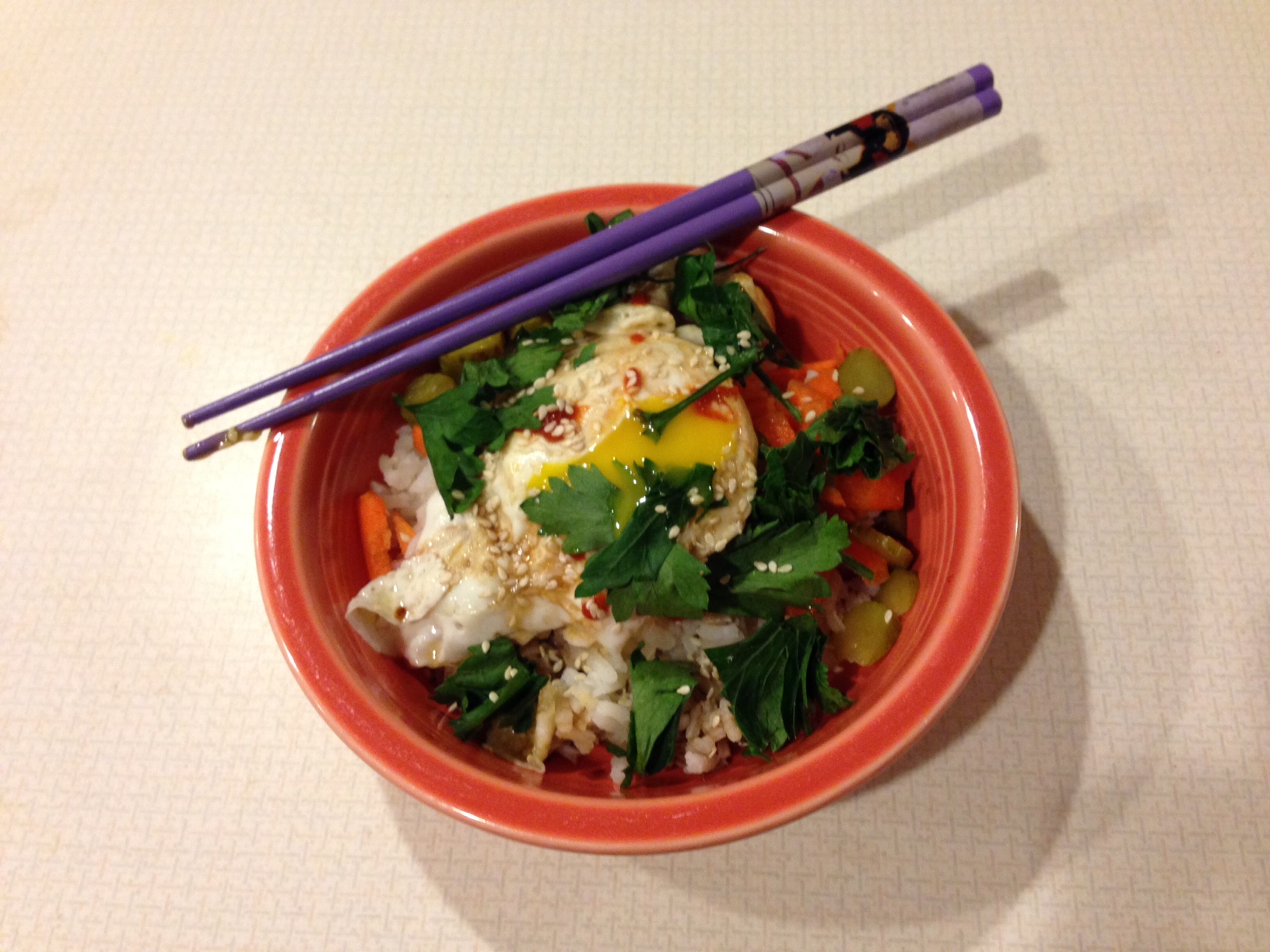
It’s a traditional Korean dish: a bowl of rice, protein, pickled vegetables, and a fried egg on top. If you’re a purist, bibimbap is made by adding rice to a very hot stone dish.  I am not a purist.  Especially not at 10 PM. I shredded some carrot, chopped some parsley and dill pickle (kimchi is traditional, but not something I keep on hand), and microwaved a bowl of rice while frying an egg whose runny yolk would, along with a drizzle of soy, a couple drops of sesame oil and sriracha, become an intensely flavorful sauce.

It surely isn’t as simple as a bowl of rice with butter, salt, and pepper, but it was maybe six minutes from idea to first bite.   I had my late semi-simple supper with a glass of ginger ale, and a conversation about a lunch we’d had, maybe five years ago, at a Korean restaurant down the block from her office—long, long before it occurred to either of us that we might one day be sharing the Country House.

I can’t remember having bibimbap since that lunch, but it won’t be five years before I have it again.

In slightly more than the time it takes to fry an egg, a few scruffy vegetables and some leftover rice can become this.

In slightly more than the time it takes to fry an egg, a few scruffy vegetables and some leftover rice can become this.

Tag Team

Sometimes we cook together, start to finish.  Sometimes one of us is on dinner duty while the other handles other chores, or isn’t even home yet.  Or it’s some combination of the two.

Knowing there would be tomatoes in this week’s CSA distribution, and realizing we still had a pile of tomatoes from last week’s share, we decided on a simple sauce to serve with pasta. While she was at work on Tuesday, I chopped the tomatoes, diced an onion, and baked some bacon.  Upon her return, she sautéed the onion, added tomatoes and capers, and cooked them until the tomatoes were soft and their juices reduced; also, she made a batch of penne. Everything was cooled and tucked away for Wednesday dinner.

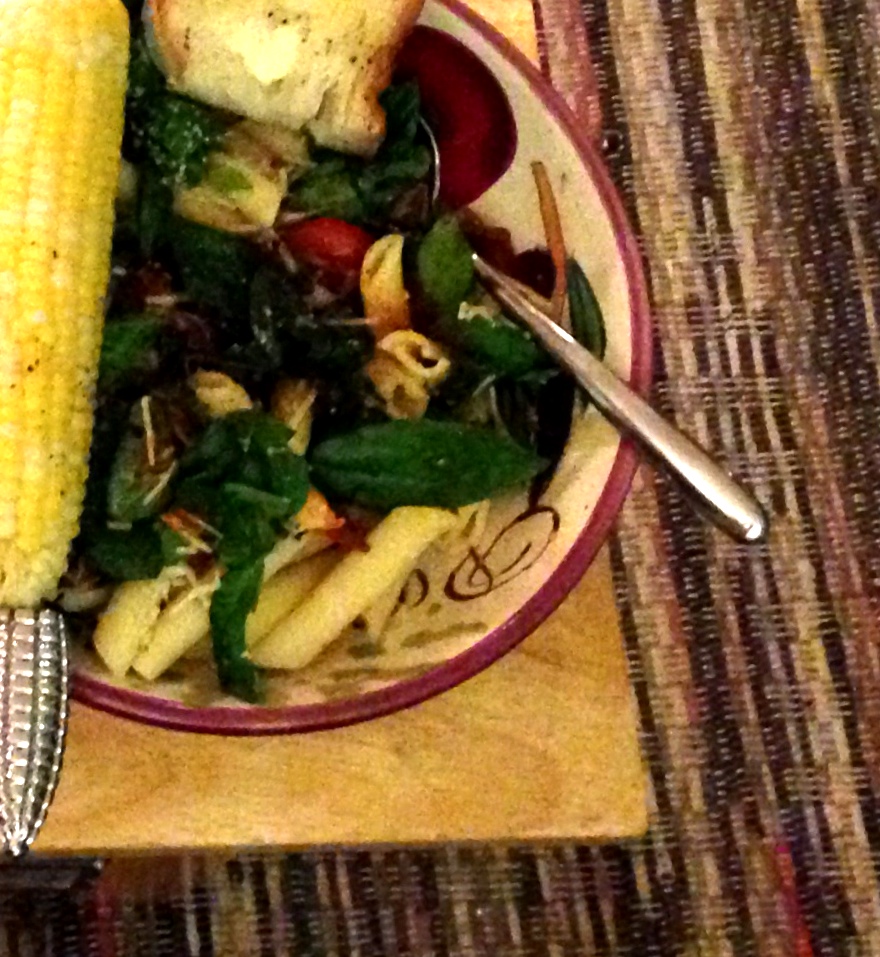
We met at the terminal for a companionable train ride home in the Quiet Car; I worked on lyrics for a new project, she read an Agatha Christie novel.  Home at the Country House, we divided labor: she cleared the laundry closet for the painter who’ll arrive this morning; I fixed dinner.  I heated the sauce, gave the pasta a hot-water dunk to warm and separate, snipped some basil, crumbled a slice of bacon, sprinkled some cheese, added a little salt and pepper, and bowled it up, along with a couple ears of late-summer corn.  She finished the closet in time to prepare croutons (small pieces of bread we use to butter ears of corn), and we settled down to enjoy the result.

It isn’t just cooking; maybe she’ll sort and start a load of laundry, and I’ll switch it to the dryer and fold it, or the other way around. Dishes are washed and dried; the dishwasher is loaded and emptied; the cats get fed and the litter box  scooped. We don’t have “assigned” chores, but everything gets done.

Sharing. Nothing fancy. But simple. And wonderful. Like a bowl of pasta and an ear of corn.

Pasta and corn. Lots of basil, in place of a salad.  I forgot the mozzarella cheese we'd planned to cube into this dish, but that means the leftovers will be different!

Pasta and corn. Lots of basil, in place of a salad. I forgot the mozzarella cheese we’d planned to cube into this dish, but that means the leftovers will be different!

The Well-Traveled Salsa, and the End of the Road

Community Supported Agriculture is a system of supporting farms based on the recognition that small farmers need an influx of cash before they have a crop to sell.   Members pay in advance for a share of a local farm’s produce, then meet once a week during the harvest season when the crop is delivered, sort of like buying a magazine subscription.  The produce is of a higher quality than most supermarket fruit and vegetables–and much tastier than Time or Car and Driver.

At a farmer’s market, customers can pick and choose, or walk away without buying anything. In a CSA, you don’t know what will be offered on any given week until an email arrives the night before distribution; but since you’ve already paid for the produce, there’s an incentive to try everything, even when it’s unfamilar.  It’s Vegetable Roulette!–oh, wow! What can we make with eggplant, radishes, and chili peppers?

When she lived in upstate New York, she bought produce from Windflower Farm at farmer’s markets, so she was delighted to continue supporting them as a New Yorker. She’s been a member of Windflower’s CSA for several years, and we’ve enjoyed virtually every bite. (Okay, bok choy not so much, but that’s just a personal preference; everything else has been dandy.)

Lately, though, her “local” vegetables have been making an odd and circuitous trip: they’re trucked from upstate to NYC, where she takes a subway train uptown to pick them up, a long walk or cab ride across town to the train station, and another commuter train home to the Country House. Because it is a peak-hour train, she and her many pounds of produce are unlikely to find a seat.  As autumn vegetables start arriving (potatoes and squash replacing airy kale and cherry tomatoes), the trip is starting to, well, weigh on her. What used to be a 15-minute subway ride followed by a 15-minute walk to her kitchen is now a 3- or 4-hour trip.  The produce is every bit as flavorful, but exhaustion is leaving a bad taste. It’s sad to think of resenting such good food, so we’re looking for someone to take over the remaining 7 weeks of this year’s season.

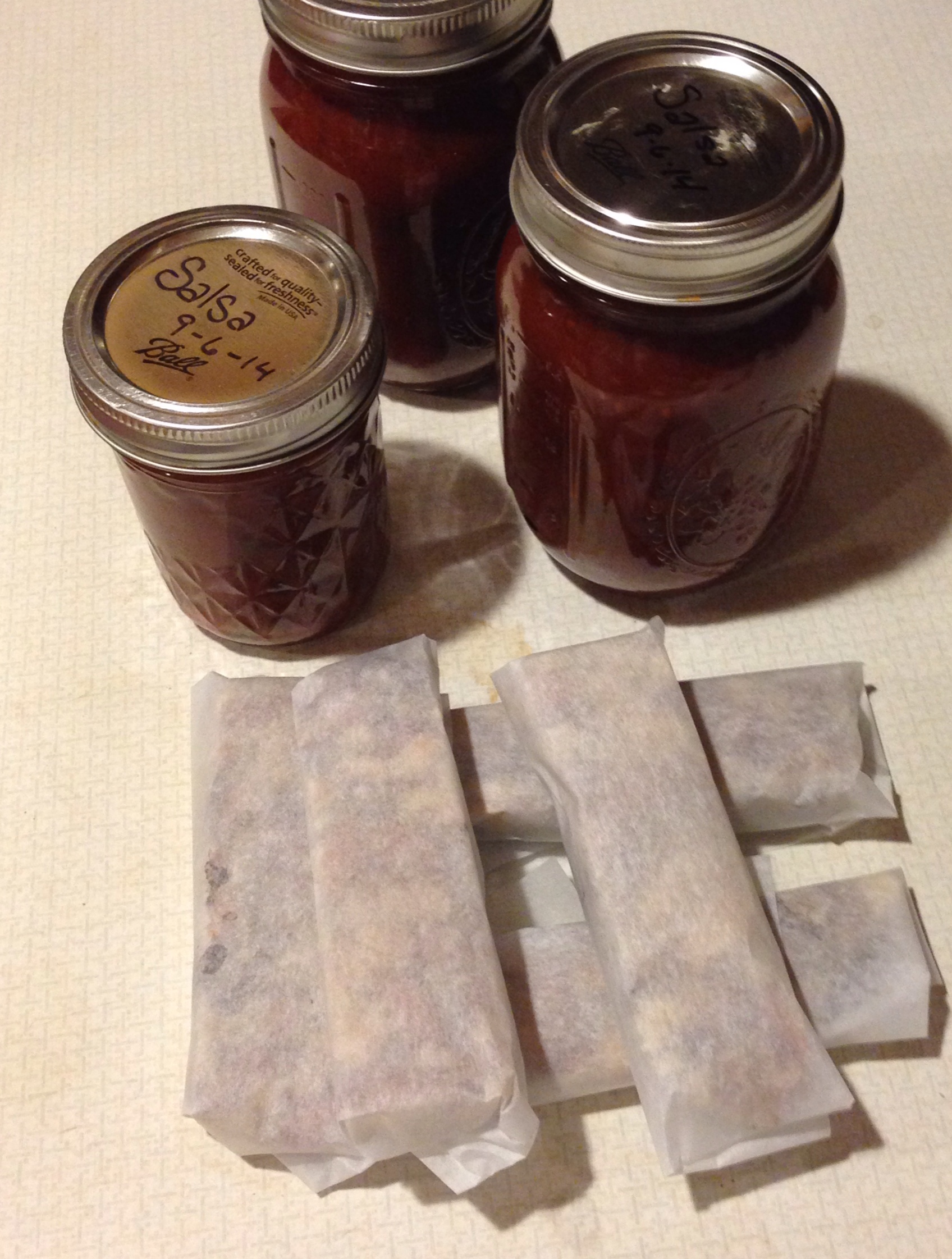
We’ll eventually find a farmer’s market here that we can get to regularly; meanwhile, we’ve got a pantry full of applesauce, pickles, and salsa to remind us of the well-traveled route that fruits and vegetables–even relatively local ones–can take.

Dipping Kind-of bars in spicy tomato salsa is not recommended

Dipping Kind-of bars in spicy tomato salsa is not recommended

Acquired Tastes

Thursday is choir night, and we still haven’t worked out that load-the-slow-cooker-at-noon thing such that dinner is ready when she gets home. She picked up something called “chicken fries” when she stopped at the market for the milk we needed for breakfast. I’m not sure if “chicken fries” are as closely related to McNuggets as they sound, but I’m not going to worry about it now.

I had the same choir-night dinner I’ve had for ages: after the choir room is set up and the night’s music has been practiced, I have a half-cup of yogurt, whatever fruit is handy, and some of our Really Good Granola sprinkled on top. It’s easy to fix, it’s light, and since there’s as much fruit as yogurt, the combination isn’t too gloppy on the vocal cords.

The thing is, although this has been my Thursday quick-supper for a long while, I can remember when I didn’t even know what yogurt was.  And then I knew, but I hated it.  (My first taste of yogurt was in the college cafeteria.  I thought it was pudding.  I nearly did a spit-take. I did not try it again for years.)

Apparently it was an acquired taste. I don’t remember when I acquired it, but I did.  Along with lots of others.

Steel-cut oatmeal. (Hated oatmeal growing up.)

Fish tacos. (What on earth is a fish taco?)

Cheese (the kind that isn’t pre-sliced and covered in plastic).

Beets.  Tomatoes. Coffee.

These things aren’t just acquired tastes, they’re positively comforting to me now. (Well, maybe coffee isn’t so much comforting as a requirement for consciousness some mornings. And afternoons. And the occasional evening.)

I wouldn’t combine them all in one meal, but if I had to plan a month’s worth of meals, they’d all be listed. Chicken fries might not make the short list, but if choir rehearsal runs a little long and there are leftovers when I get home, who knows?